
Nine people lost their lives when a Learjet 60 crashed in Palm Beach County, Florida, on November 1, 2026. Our sympathies are with their families, friends, colleagues, and the people whose community was affected.
The NTSB investigation is ongoing. Reports of icing, turbulence, and a rapid descent raise serious questions, but the probable cause has not been determined. We can reflect on established weather-safety practices while investigators work to understand this flight.
What the early reports describe
The FAA's initial statement says the Learjet was traveling from Austin, Texas, to North Eleuthera in the Bahamas when it crashed near Cresthaven around 12:50 p.m. local time. The NTSB identifies the investigation as ERA27MA026.
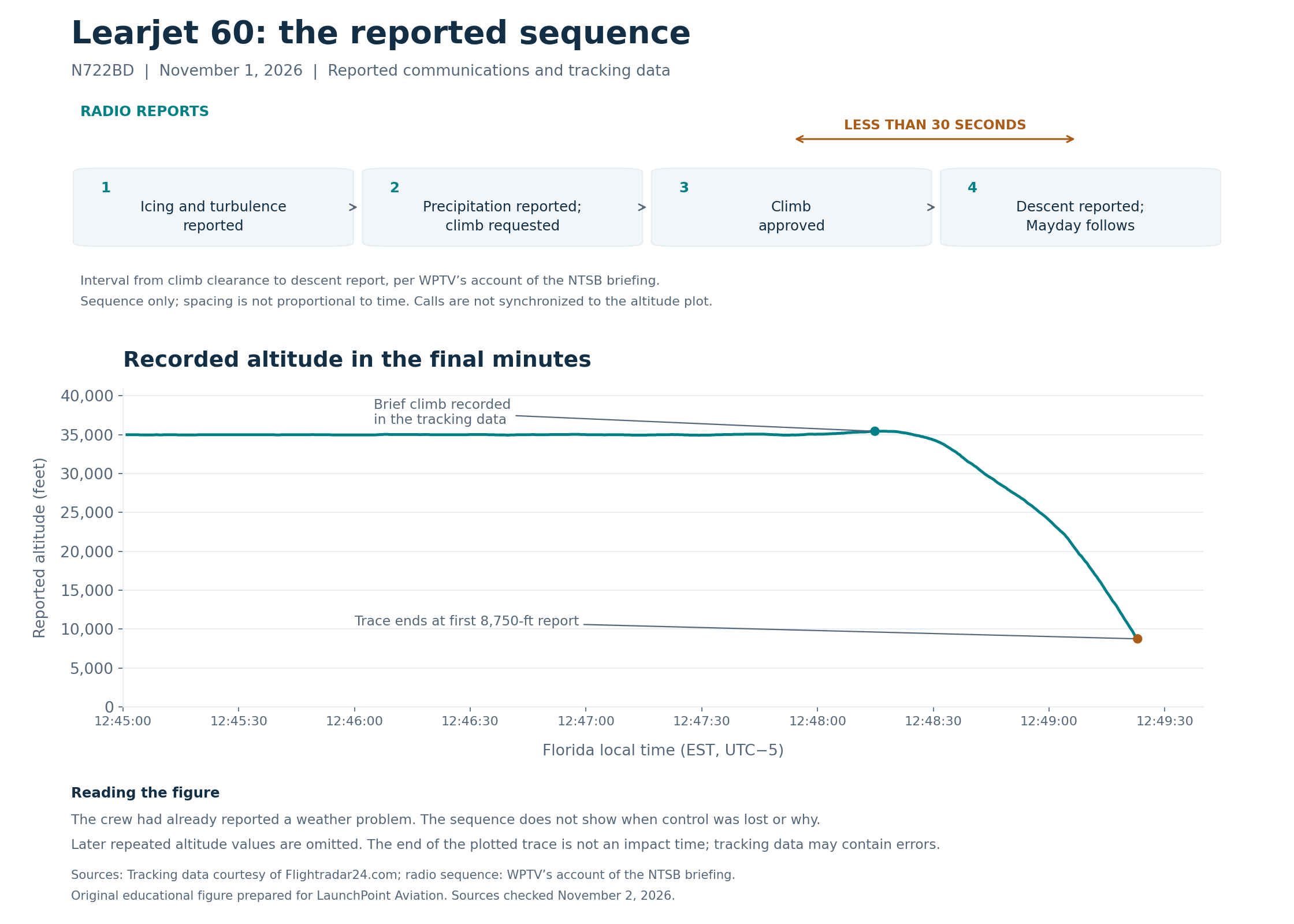
Published accounts of the NTSB briefing and public radio-recording transcripts describe the following sequence. This is a paraphrase of preliminary accounts, not an official FAA transcript. Flight levels refer to pressure altitude; FL350 and FL370 correspond to nominal altitudes of 35,000 and 37,000 feet.
| Stage | Reported communication |
|---|---|
| Initial weather report | Near FL350, the crew reported manageable light clear icing and moderate turbulence, with altitude excursions of approximately 700 feet. |
| Request for improved conditions | The controller requested the outside temperature. The crew reported approximately minus 47 degrees Celsius and asked about a smoother ride. |
| Climb request | The crew reported precipitation and requested FL370. ATC approved the climb; a public transcription also includes a traffic-related restriction against turning farther right. |
| Developing emergency | Shortly afterward, the crew reported a rapid descent, transmitted a distress call, and reported an overspeed condition. |
| ATC response | The public transcription records the controller offering altitude discretion, asking what assistance was needed, and continuing to attempt contact. |
 Enlarge graphic
The principal sources for this sequence are WPTV's account of the NTSB briefing and an unofficial transcription of the circulated ATC recording. Transcriptions can contain errors or omit context. We have omitted ambiguous and distressing final calls.
Flightradar24's published tracking account separately describes a brief climb followed by a steep descending turn. Tracking observations help establish movement, but do not explain the cockpit indications or the event that initiated the emergency.
WPTV’s account of the NTSB briefing reports less than 30 seconds from the climb clearance to the descent transmission. That interval does not measure the duration of the earlier reported 700-foot deviation. An exact, synchronized call-by-call timeline has not been verified; the sequence graphic does not assign radio calls to points on the altitude trace.
What a reported 700-foot deviation means
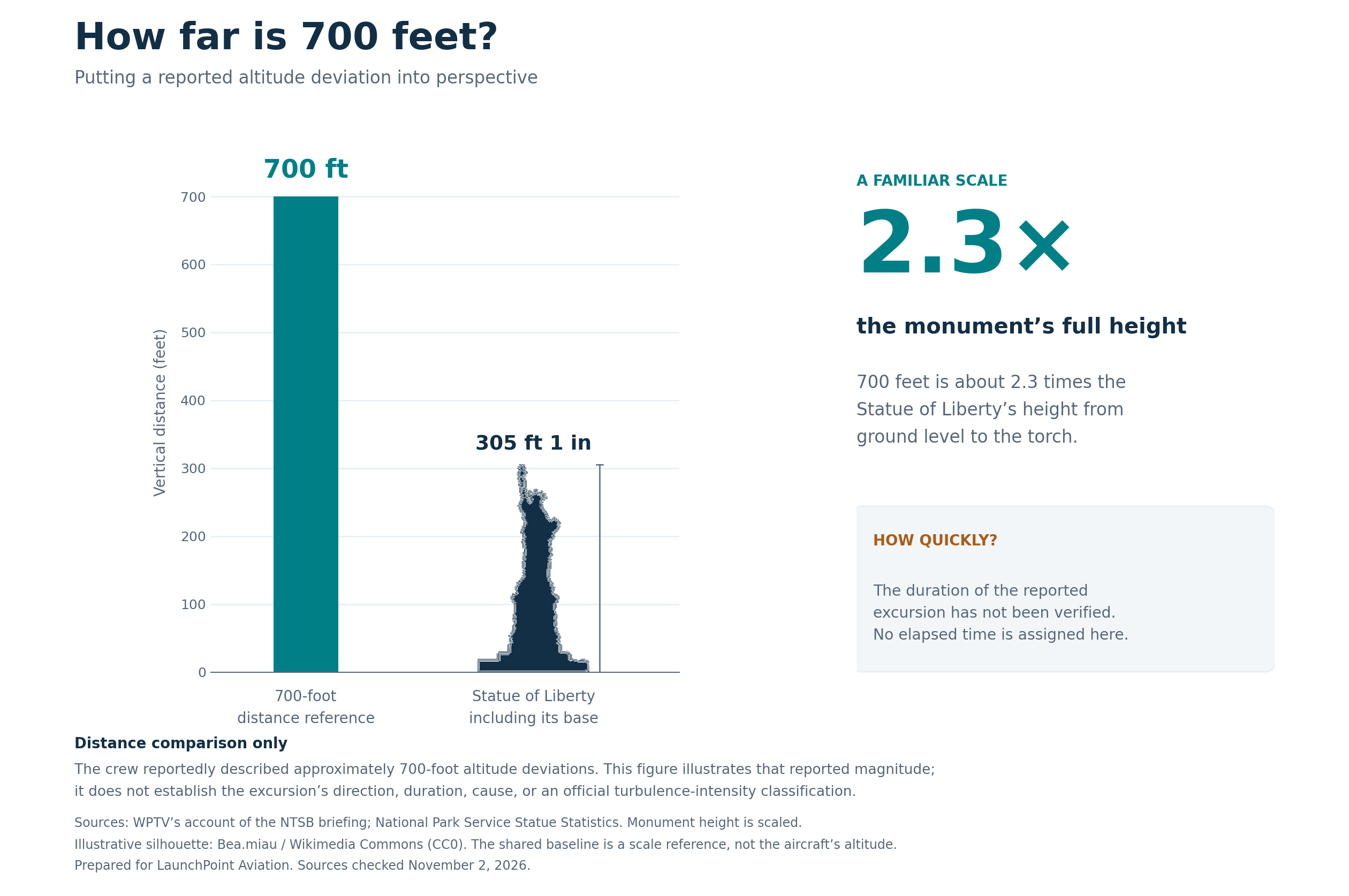
The crew reportedly described moderate turbulence with altitude deviations of approximately 700 feet. For scale, the Statue of Liberty measures 305 feet, 1 inch from ground level to the torch, including its base. A 700-foot vertical distance is therefore approximately 2.3 times the monument's full height. This comparison illustrates the reported magnitude; it does not establish the excursion's direction or duration. (WPTV, account of the November 2 NTSB briefing (reported altitude deviations and clearance-to-descent interval); National Park Service, Statue Statistics)
 Enlarge graphic

Turbulence descriptions refer to the aircraft's response, including its controllability. FAA guidance describes moderate turbulence as involving altitude or attitude changes while control is retained. Severe turbulence can involve abrupt changes and temporary loss of control. A reported number of feet alone does not establish a different intensity classification. Nor does an altitude plot independently verify every cockpit report. These distinctions help readers understand the report without implying that this encounter represents routine conditions on every flight. (FAA AIM 7-1-21, PIREPs Relating to Turbulence)
Why an icing report does not establish the cause
An icing report is evidence of what the crew observed and communicated. Understanding its effects requires information about the accumulation, affected surfaces, aircraft configuration, and operation of the protection systems.
Ice can impair aerodynamic performance and handling. The FAA's Pilot Guide to Flight in Icing Conditions also explains that an autopilot can mask developing changes. Pilots must follow their aircraft's approved limitations and procedures, monitor performance, and maintain an exit plan that is reassessed as conditions change. Ice protection does not make every icing encounter acceptable.
The reported temperature warrants particular care. NASA's explanation of icing physics describes ordinary airframe icing as supercooled liquid droplets freezing on the aircraft, most frequently at substantially warmer temperatures than minus 47 degrees Celsius. The radio report does not establish when ice accumulated or provide a complete measurement of the cloud environment.
High-altitude ice crystals present a separate hazard around deep convection. NASA research explains how crystals ingested into turbine engines can affect engine operation. That mechanism differs from clear ice forming on a wing. Its existence does not establish an engine-icing event on this flight.
Thunderstorm avoidance begins before an encounter
The FAA's 2026 Aviation Weather Handbook, section 22.8.2, advises avoiding severe thunderstorms and intense, heavy, or extreme radar echoes by at least 20 miles. Hazards can extend beyond a visible cloud or echo, so that distance should not be treated as a guarantee that every nearby route is safe.
For pilots, the practical implication is to preserve alternatives before approaching hazardous weather. A route change, delay, or diversion can keep a flight away from a developing problem. The FAA's thunderstorm guidance cautions against flying beneath thunderstorms or their anvils and against relying on a narrow apparent opening.
A climb is not automatically an escape. At high altitude, aerodynamic and performance margins depend on the aircraft's weight, speed, temperature, and loads from maneuvering or gusts. The FAA discusses these considerations in AC 61-107B. Evaluating the Learjet's climb request requires its actual operating conditions and approved performance data; the timing alone does not establish that the request was improper.
What radar can and cannot show
A weather image represents a particular product assembled from observations at particular times and heights. An aircraft track laid over that image does not, by itself, establish the conditions at the aircraft's altitude. A sound reconstruction must account for the radar scans, vertical coverage, aircraft position, and movement of the weather.
ATC precipitation displays do not directly measure turbulence. Some onboard Doppler systems can identify turbulence associated with precipitation, but they do not remove every detection limitation. Neither a light return nor a gap on a screen guarantees smooth or safe conditions.
Datalink weather adds a timing issue. The NTSB's radar-mosaic safety alert warns that, in unusual latency scenarios, underlying observations can be 15-20 minutes older than the displayed mosaic age. This is not a claim about the equipment or imagery used on the Learjet. It explains why a recently refreshed display should not be treated as a live view of a narrow route through rapidly changing weather.
How pilots and ATC work together
The reported traffic-related heading restriction illustrates why a weather request may interact with aircraft-separation requirements. The available excerpts do not establish where other traffic was, which alternative clearances were available, or what controllers coordinated. They cannot support a conclusion that ATC prevented a safe escape.
Controller procedures require pertinent weather information and provide for weather-avoidance assistance. Pilot and controller responsibilities overlap: pilots must also request clarification or an amendment when a clearance is unacceptable from a safety standpoint. An altitude clearance does not certify that conditions there will be suitable for a particular airplane.
A useful request explains both the difficulty and the assistance needed. During training, practice communicating a weather concern clearly, requesting a route or altitude change, and stating when a proposed clearance is unacceptable. Those are general training exercises, not a reconstruction of what this crew should have said.
Mayday: ask for help when safety is in doubt
Mayday is the international voice signal for distress: serious or imminent danger requiring immediate assistance. PAN-PAN signals an urgency condition: safety is a concern and timely assistance is needed, although immediate assistance is not yet required. FAA guidance encourages pilots to request help when uncertainty about weather, fuel, position, or another condition begins affecting safety. A pilot does not need to wait for a situation to become catastrophic before asking for assistance. (FAA Pilot/Controller Glossary, Distress; FAA Pilot/Controller Glossary, Urgency; FAA AIM 6-1-1 and 6-1-2, pilot authority and early assistance)
For distress, begin with “Mayday,” preferably repeated three times. State the problem and the help needed clearly. If a pilot cannot recall a formal format, plain language still communicates the emergency; controllers are instructed to respond to an apparent emergency even when the standard signals are absent. (FAA AIM 6-3-1 and 6-3-2, communications, frequency, transponder, and message elements; FAA Order JO 7110.65, 10-1-1 through 10-1-4, emergency handling and coordination)
A training prompt—not a quotation from this accident—is: “Mayday, Mayday, Mayday. [Call sign and aircraft type]. [Emergency]. [Position and altitude]. [Intentions and assistance needed].”
Practice that communication with an instructor as part of aircraft-specific emergency training. This discussion does not judge the Learjet crew's timing or communications.
What starts happening after an emergency call
The pilot and controller may work in parallel; the following is an overview rather than a rigid sequence:
- Fly the airplane. Maintain control, manage the flight path, and use the applicable emergency procedures. Radio work must fit around those priorities. (FAASTeam, Positive Aircraft Control, aviate/navigate/communicate)
- Communicate the immediate need. Use the ATC frequency already providing service when possible. If contact cannot be established, or circumstances require it, 121.5 MHz is available for emergency communications. (FAA AIM 6-3-1 and 6-3-2, communications, frequency, transponder, and message elements)
- Give essential information first. Identify the aircraft, explain the emergency, and say what assistance is needed. Provide position and altitude when needed. ATC can start acting once it has sufficient information; a complete questionnaire is not a prerequisite to assistance. (FAA Order JO 7110.65, 10-2-1 and related emergency assistance provisions)
- ATC responds and coordinates. The controller assesses the request, provides assistance, and coordinates with other facilities. A distressed aircraft receives priority over other traffic. Depending on circumstances, assistance can include traffic management, navigation help, and coordination toward a suitable landing option. (FAA Order JO 7110.65, 10-1-1 through 10-1-4, emergency handling and coordination; FAA Order JO 7110.65, 10-2-1 and related emergency assistance provisions; FAA Order JO 7110.65, 2-1-4, operational priority)
- Add details as workload permits. Controllers may ask for fuel endurance in minutes, the number aboard, weather, and other information relevant to the response. Airport emergency services or search-and-rescue coordination may be involved when warranted. (FAA AIM 6-3-1 and 6-3-2, communications, frequency, transponder, and message elements; FAA Order JO 7110.65, 10-2-1 and related emergency assistance provisions)
- Keep communicating limitations. Tell ATC if an instruction cannot be followed safely. The pilot in command retains emergency authority; when immediate action requires a deviation from an ATC clearance, notify ATC as soon as possible and obtain an amended clearance. (FAA AIM 6-1-1 and 6-1-2, pilot authority and early assistance; 14 CFR 91.3, pilot-in-command responsibility and emergency authority)
A transponder detail also matters: when already in radio contact with ATC, retain the assigned code unless instructed otherwise. If unable to establish communications promptly, FAA guidance provides for squawking 7700 with altitude reporting. Do not delay controlling the aircraft to complete a radio or transponder task. (FAA AIM 6-3-1 and 6-3-2, communications, frequency, transponder, and message elements; FAASTeam, Positive Aircraft Control, aviate/navigate/communicate)
For student pilots, the lesson is to practice requesting assistance early, recognize the difference between urgency and distress, and understand how ATC can help. Aircraft-specific procedures and qualified instruction remain essential.
Weather habits to practice during pilot training
For readers exploring flight training near Springfield, Nixa, Ozark, or Branson, these subjects belong in early conversations with a qualified instructor:
- Set personal weather limits for the pilot's experience and the aircraft's approved capabilities.
- Choose alternatives before departure and reassess them as the weather changes.
- Learn the limits of the weather products and equipment available in the airplane.
- Practice requests for assistance and the approved procedures before a demanding flight.
- Review weather decisions afterward, including decisions to stay on the ground.
A business jet's capabilities should not be assumed to apply to a training airplane. Likewise, an instrument rating does not expand an aircraft's approved operating limitations.
For further reading, our guides to learning to fly near Springfield and planning flight training while working full time address choosing a training path and making room for preparation and study.
Respecting the investigation and those affected
As investigators develop the evidence, their findings may change our understanding of this flight. The reported weather encounter deserves investigation, and the people affected deserve an account that keeps facts, open questions, and general safety guidance distinct.
For our own flying, the opportunity is to revisit how we prepare for weather, preserve alternatives, and communicate a developing difficulty. Doing that carefully is one way to approach this tragedy with respect.
This article provides general education. Aircraft-specific decisions and procedures must follow the applicable flight manual, operating rules, and qualified instruction. See our sources and corrections policy.
Sources
- FAA initial accident statement, November 1, 2026 Cresthaven entry.
- NTSB investigation ERA27MA026.
- WPTV account of the NTSB November 2 briefing.
- Unofficial public ATC transcription.
- Flightradar24 tracking account.
- NASA Basic Icing Physics.
- NASA high-altitude ice-crystal research.
- FAA AC 91-74B Flight in Icing Conditions, especially chapter 5.
- FAA AC 61-107B with Change 1, chapter 3.
- FAA Aviation Weather Handbook 2026, section 22.8.2.
- FAA AIM Meteorology, weather assistance and thunderstorm guidance.
- NTSB Safety Alert SA-017.
- FAA controller weather procedures, paragraph 2-6-4.
- FAA pilot and controller roles.
- FAA pilot responsibility and early assistance.
- National Park Service, Statue Statistics.
- FAA Pilot/Controller Glossary, Distress.
- FAA Pilot/Controller Glossary, Urgency.
- FAA AIM 6-3-1 and 6-3-2, communications, frequency, transponder, and message elements.
- FAA Order JO 7110.65, 10-1-1 through 10-1-4, emergency handling and coordination.
- FAASTeam, Positive Aircraft Control, aviate/navigate/communicate.
- FAA Order JO 7110.65, 10-2-1 and related emergency assistance provisions.
- FAA Order JO 7110.65, 2-1-4, operational priority.
- 14 CFR 91.3, pilot-in-command responsibility and emergency authority.
- Statue of Liberty silhouette: Bea.miau / Wikimedia Commons, CC0.