
For many eligible applicants pursuing daytime sport-pilot privileges, FAA regulations permit the use of a current and valid United States driver’s license instead of an FAA medical certificate. Specific eligibility requirements and limitations apply. The rule is not accurately summarized as “an FAA medical is never required,” because prior FAA medical history, license restrictions, current health, and the operation being conducted all matter.[1][3]
A driver’s license is evidence used within a regulatory pathway; it is not an FAA finding that a person is medically safe to fly. Every pilot remains responsible for not operating while knowing—or having reason to know—of a medical condition that would make the operation unsafe.[2] Night operations have an additional medical qualification requirement. Anyone with questions about a past or pending FAA medical matter should review current official sources and seek appropriate individualized guidance before acting.
Accurate as of July 22, 2026.
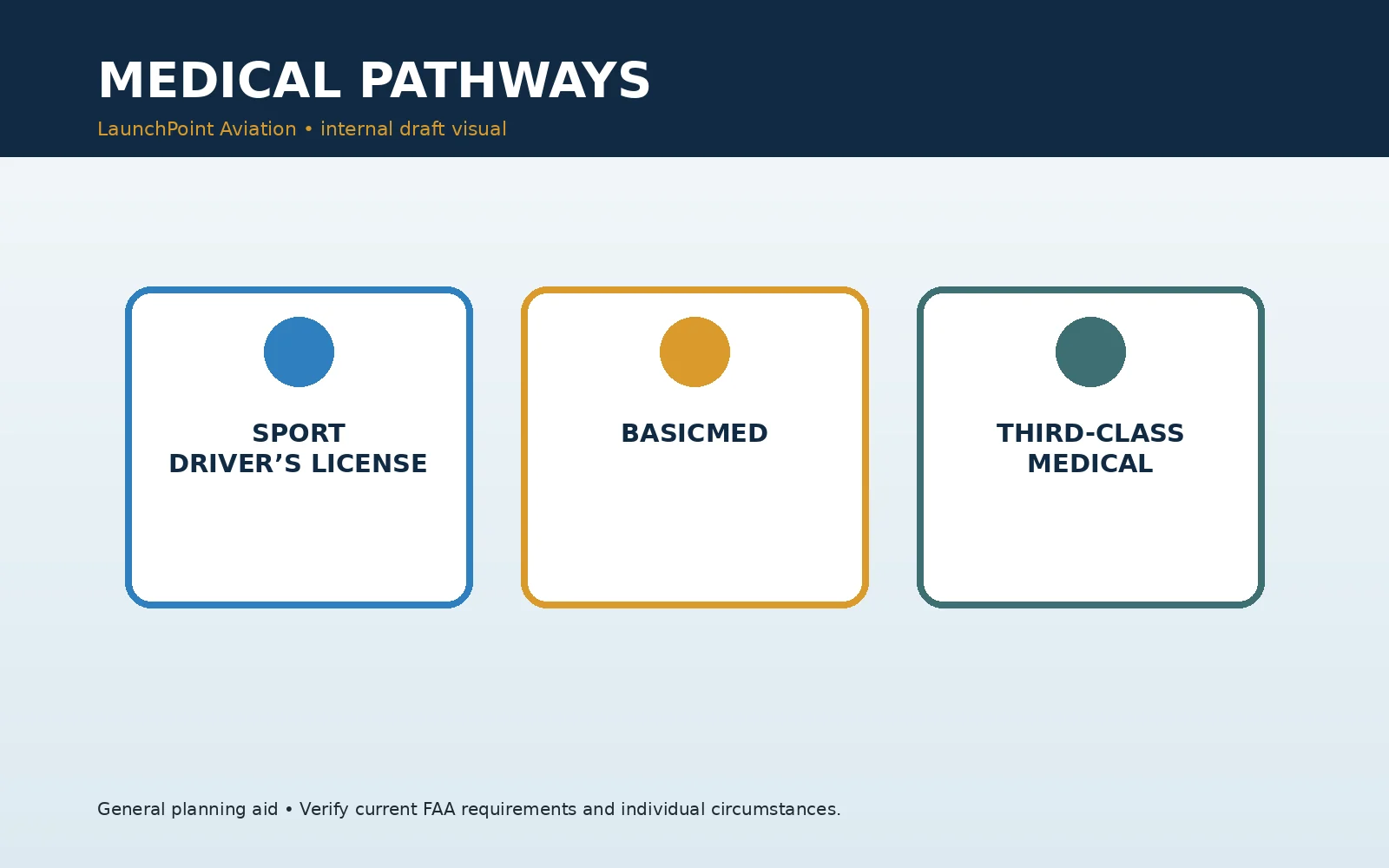
Table of contents
- The direct rule
- How the driver’s-license pathway works
- When it may not be available
- Medical safety and self-grounding
- Prior applications and outcomes
- Day and night
- When to seek guidance
- Privacy
- Frequently asked questions
The direct rule in plain English
An eligible person may act as pilot in command while exercising sport-pilot privileges using either an applicable FAA medical certificate or a current and valid U.S. driver’s license, subject to the conditions in §§ 61.23 and 61.303.[1][3] A student pilot seeking sport-pilot privileges in a powered aircraft uses the same basic document choices for the operations covered by the rule.
The driver’s-license option is most straightforward when the person has a valid license, follows its restrictions, has no disqualifying FAA medical application or enforcement history, and has no known reason that safe flight would be compromised. But the precise outcome can depend on a sequence of facts. That is why an interest form or a general article cannot “clear” an individual.
How the driver’s-license pathway works
The pathway includes several separate conditions. In practical language, a person relying on a driver’s license must:
- hold a current and valid U.S. driver’s license;
- comply with any restrictions imposed on that license;
- have been found eligible for at least a third-class FAA medical at the time of the most recent application, if the person has applied;
- not have had the most recently issued FAA medical certificate suspended or revoked;
- not have had the most recent special-issuance authorization withdrawn; and
- not know or have reason to know of a medical condition that would make safe operation impossible.[1][3]
Those conditions should be read together. Possessing a plastic driver’s-license card answers only the first part. It does not erase a later FAA denial, a current suspension, a withdrawn special issuance, or the separate self-grounding obligation.
Student pilots
A student can receive dual instruction without acting as pilot in command. Before solo in a powered aircraft, the student must satisfy the applicable student-certificate, endorsement, and medical-document rules. A school’s insurer may impose requirements more restrictive than the federal minimum. A school may therefore lawfully decline driver’s-license-only solo operations even when a person believes the federal pathway is available.
Insurance and school policy do not decide federal eligibility, and federal eligibility does not compel an insurer or aircraft owner to accept a risk. Both layers must be confirmed before a training plan assumes solo access.
When the pathway may not be available
The following situations require individualized review:
| Situation | Why it matters | Sensible next step |
|---|---|---|
| Most recent FAA medical application was denied | The rule requires the most recent application, if any, to have resulted in eligibility for at least third class | Review the actual record and current FAA rules with qualified guidance |
| Most recent medical was suspended or revoked | The regulation expressly addresses those outcomes | Do not assume an expired card and an enforcement action are equivalent |
| Special issuance was withdrawn | The driver’s-license pathway contains a specific condition | Obtain individualized advice before acting |
| A medical application is pending or deferred | The last FAA disposition may be unresolved | Avoid relying on forum summaries; confirm the status and governing rule |
| Driver’s license is expired, suspended, or restricted | The license must be current and its limitations followed | Resolve or comply with the state-license issue |
| Person knows of a potentially unsafe condition | All pilots remain subject to medical-deficiency rules | Do not fly; consult an appropriate physician and official FAA material[2][4] |
| Intended flight is at night | Section 61.329 adds a medical pathway beyond daytime driver’s-license use | Review the night endorsement and medical requirements before planning |
This table does not diagnose any person or predict an FAA decision. It identifies the kinds of facts that change the legal analysis.
Legal document pathway versus fitness to fly
“Not required to hold an FAA medical certificate for this operation” and “fit to fly today” are different statements. Section 61.53 prohibits operations during a known medical deficiency. The FAA’s sport-pilot medical FAQ advises a person who suspects a significant condition to consult a private physician about safe performance.[2][4]
The responsibility is continuous. A pilot can be eligible to use a driver’s license on Monday and still need to self-ground on Tuesday because of illness, fatigue, medication effects, an injury, or another condition affecting safe operation. A valid medical certificate likewise does not override the duty to self-ground.
This safety principle should be part of training culture without turning instructors into clinicians. An instructor can discuss operational fitness, aeronautical decision-making, and the requirement not to fly when impaired. Diagnosis, treatment, and individualized FAA medical strategy belong with qualified professionals.
Prior FAA medical applications and outcomes
No prior application
If a person has never applied for an FAA medical certificate, the “most recent application” condition may not be triggered in the same way as it is for a prior applicant. Other requirements still apply: a current valid driver’s license, compliance with its restrictions, and no known reason that safe operation would be compromised.[1]
That does not make avoidance of an application a strategy for a particular medical condition. This article does not advise anyone to apply, not apply, withdraw, delay, or conceal information. The appropriate decision depends on the person’s goals and circumstances.
Expiration
Expiration is not the same event as denial, suspension, or revocation. A person whose most recent FAA medical was issued and later expired may be differently situated from someone whose most recent application was denied. Even so, the person must still satisfy all current driver’s-license pathway conditions and should verify the effect of any later application, special issuance, or enforcement event.
Denial, suspension, revocation, or withdrawn special issuance
These words have distinct meanings and should not be used interchangeably. Sections 61.23 and 61.303 focus on specified events involving the most recent application, certificate, and special-issuance authorization.[1][3] An internet article cannot determine which record is legally operative or whether a later event changed the result.
An adverse FAA medical history may prevent use of the driver’s-license pathway. Review current FAA sources and obtain individualized professional guidance before relying on this pathway.
Day versus night operations
Daytime operations are the context in which the ordinary driver’s-license pathway is most often discussed. After MOSAIC, sport pilots may earn a night-operating endorsement, but § 61.329 requires additional ground and flight training, an instructor endorsement, and a medical qualification beyond the ordinary daytime driver’s-license-only route.[3]
The current rule calls for either at least a third-class medical certificate or a U.S. driver’s license while meeting the BasicMed requirements incorporated through § 61.113(i). The sport pilot must also complete specified night training, including a night cross-country flight and full-stop takeoffs and landings, subject to the category-specific provisions.[3]
BasicMed does not transform sport-pilot privileges into private-pilot privileges. A pilot using BasicMed for the sport-night pathway must still observe sport-pilot aircraft, passenger, airspace, and other limitations.
When individualized guidance may be appropriate
Consider obtaining individualized guidance before relying on the pathway when:
- an FAA medical application is pending, deferred, denied, or otherwise unresolved;
- a medical certificate was suspended or revoked;
- a special-issuance authorization was withdrawn;
- the chronology of applications and certificates is unclear;
- the intended operation includes night flight;
- a condition, symptom, medication, treatment, or recovery raises a fitness-to-fly concern; or
- the person’s longer-term plan may require a private, commercial, or higher certificate.
Depending on the question, appropriate help might include the FAA, an aviation medical examiner, a treating physician, an experienced flight instructor, or qualified legal counsel. Each has a different role. A treating physician may assess health and functional safety but may not interpret every certification consequence; legal or regulatory counsel may interpret rules but should not diagnose medical fitness.
What not to send through a marketing website
LaunchPoint’s public website and 2027 Interest List are not medical-screening or airman-certification systems. Do not submit:
- diagnoses or symptom histories;
- medication lists;
- FAA medical applications, denials, or special-issuance files;
- physician notes or test results;
- driver’s-license numbers or images;
- Social Security numbers or government identification; or
- financial or insurance records.
The interest list is for development updates and aggregate market planning. LaunchPoint does not use the interest list to collect or evaluate medical eligibility. Any future eligibility intake will use appropriately restricted processes kept separate from ordinary marketing analytics.
Frequently asked questions
Does every sport pilot qualify with only a driver’s license?
No. The pathway is conditional. A person must satisfy the current regulations, including provisions concerning prior FAA medical history, current driver’s-license status, license restrictions, and medical deficiency.[1][2][3]
What if an FAA medical certificate simply expired?
Expiration is not the same as denial, suspension, or revocation. The complete history still matters, including whether a later application was filed or a special-issuance action occurred. Verify the current rule and obtain guidance for the actual facts.
What if the most recent medical application was denied?
Do not assume a driver’s license restores eligibility. The most-recent-application condition in the sport-pilot rules is directly relevant. Individualized regulatory guidance may be appropriate.
Can LaunchPoint review my medical records?
No. Do not send medical records or sensitive identifiers through the website. LaunchPoint is not presently operational and its public interest process is not an eligibility determination.
This article provides general aviation and regulatory information only. It does not determine any individual’s legal, medical, or operational eligibility to act as pilot in command. Readers should review current FAA materials and obtain appropriate individualized guidance when necessary.
Sources and further reading
[1] Electronic Code of Federal Regulations, “14 C.F.R. § 61.23—Medical certificates”. Reviewed 2026-07-22.
[2] Electronic Code of Federal Regulations, “14 C.F.R. § 61.53—Operations during medical deficiency”. Reviewed 2026-07-22.
[3] Electronic Code of Federal Regulations, “14 C.F.R. Part 61, Subpart J—Sport Pilots”. Reviewed 2026-07-22.
[4] Federal Aviation Administration, “Medical deficiency and sport-pilot driver’s-license FAQ”. Reviewed 2026-07-22.
[5] Federal Aviation Administration, “Medical Certification”. Reviewed 2026-07-22. Published or updated 2026-03-23.
[6] Federal Aviation Administration, “Sport Pilot”. Reviewed 2026-07-22. Published or updated 2026-04-15.
The eCFR is continuously updated and is authoritative but unofficial.
Related LaunchPoint guides
- the medical-pathway comparison — BasicMed, a Third-Class Medical, and Sport-Pilot Privileges Compared
- the complete sport-pilot requirements guide — Sport Pilot License Requirements: A Complete Current Guide
- the current MOSAIC overview — What MOSAIC Changed for Sport Pilots
LaunchPoint pre-launch disclosure
LaunchPoint Aviation Group, LLC is currently developing a proposed sport-pilot training program for the Ozarks, with an anticipated launch in 2027. LaunchPoint is not presently offering flight instruction, aircraft rental, enrollment, scheduling, discovery flights, or paid aviation services. Program details, aircraft, instructors, airport location, pricing, and launch timing remain subject to change.
Corrections and updates
To report a possible error or suggest an update, contact admin@launchpointaviation.com with the article title, the passage in question, and a link to any supporting official source. Do not send medical records, diagnoses, government identifiers, or other sensitive personal information.
Stay informed
Interested in sport-pilot training in the Ozarks?
Join the LaunchPoint Aviation 2027 Interest List to receive occasional development updates and be notified when enrollment information becomes available.
Joining the interest list is not enrollment, does not reserve a position, and creates no payment obligation.