
A sport-pilot certificate is an FAA pilot certificate for defined recreational operations. For airplane privileges, the current federal path generally requires an applicant to be at least 17, read and communicate in English, receive the required ground and flight training, log at least 20 hours that satisfy the specific experience categories in 14 C.F.R. § 61.313, and pass both a knowledge test and a practical test.[1] Twenty hours is a regulatory floor, not a promised completion time.
Medical qualification is a separate question. For many eligible applicants pursuing daytime sport-pilot privileges, FAA regulations permit the use of a current and valid United States driver’s license instead of an FAA medical certificate. Prior FAA medical history, current fitness, night operations, and other conditions can change the answer. The complete pathway is therefore a sequence of eligibility, training, endorsements, experience, testing, and operating limitations—not simply a short hour requirement.
Accurate as of July 22, 2026.
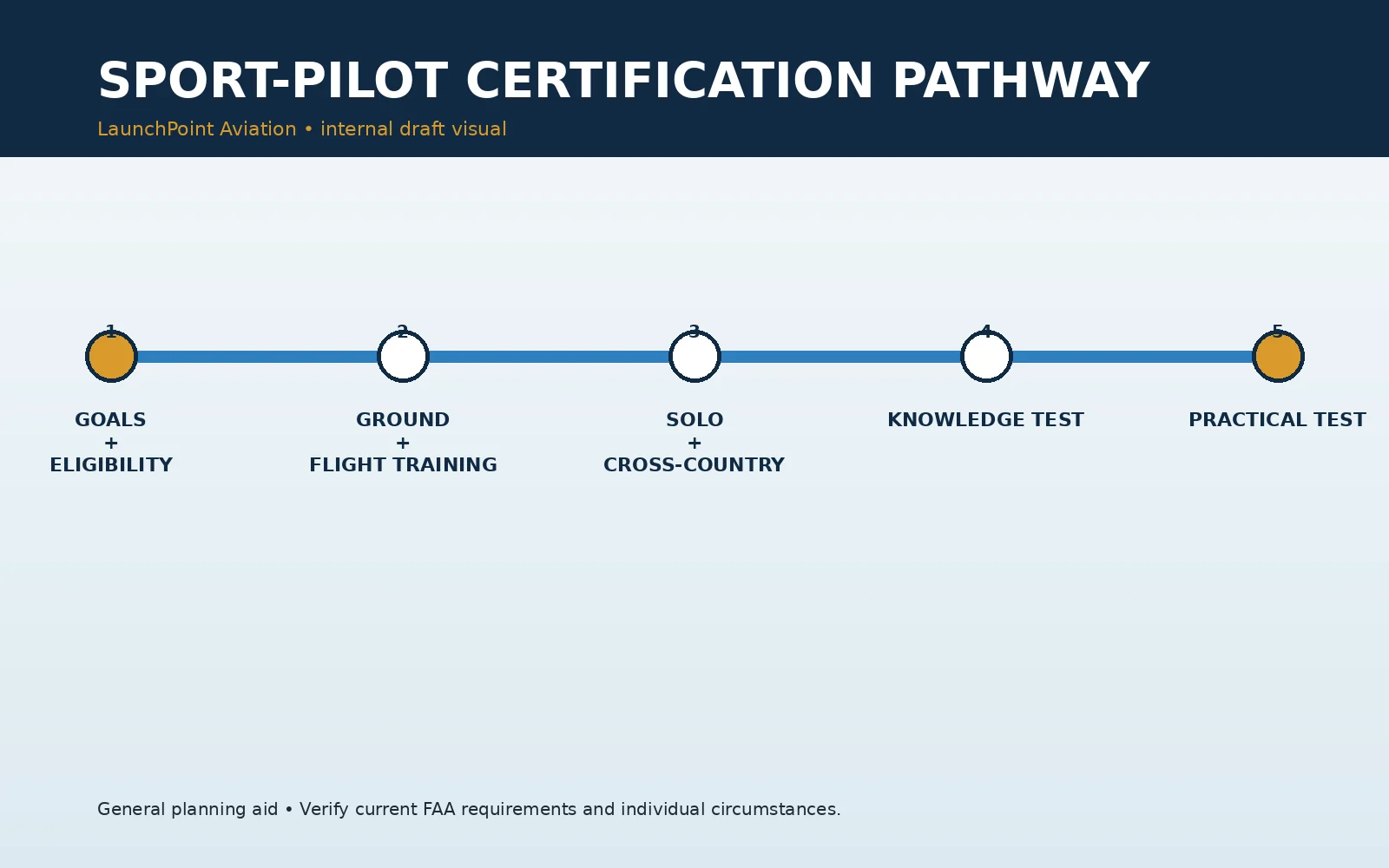
Table of contents
- What the certificate is
- Requirements at a glance
- Eligibility and age
- Student-pilot and medical steps
- Knowledge and flight training
- Solo and cross-country experience
- Knowledge test and checkride
- Privileges and limitations
- Realistic completion planning
- Frequently asked questions
What a sport-pilot certificate is
The FAA calls the credential a sport-pilot certificate. People commonly search for a “sport pilot license,” so both expressions appear in this guide, but “certificate” is the regulatory term.
The certificate is built for recreational flying within a defined set of privileges and limitations. It is not an airline or commercial-pilot credential. A sport pilot may act as pilot in command only when the pilot, aircraft, flight, airspace, weather, and any required endorsements all fit the governing rules. MOSAIC expanded the range of qualifying aircraft and created additional endorsement paths; it did not turn sport-pilot privileges into unrestricted private-pilot privileges.[1][3]
Sport pilot can be a complete recreational destination or a starting point. A pilot may later pursue a private-pilot certificate and apply qualifying prior training and flight experience toward the later requirements. The later applicant must still satisfy every requirement for the certificate sought.
Requirements at a glance
| Requirement | Current airplane pathway | Practical meaning |
|---|---|---|
| Certificate age | At least 17 | Training may begin earlier; airplane solo generally requires age 16 |
| Language | Read, speak, write, and understand English | Limited exceptions exist for documented medical reasons |
| Student eligibility | Student-pilot certificate before solo | Dual instruction may begin before the student certificate is issued |
| Medical qualification | Applicable FAA medical or eligible U.S. driver’s-license pathway for many daytime operations | Individual history and intended operations matter |
| Ground knowledge | Training or home study plus instructor endorsement | Covers regulations, weather, performance, navigation, decision-making, and more |
| Flight experience | At least 20 hours meeting § 61.313 categories | A minimum, not a completion estimate |
| Solo | At least 5 hours within the required airplane experience | Requires aircraft-specific and time-limited endorsements |
| Knowledge test | FAA Sport Pilot Airplane test | Instructor authorization is required; current matrix lists 40 questions and a 70 percent passing score[5] |
| Practical test | Oral evaluation and flight with an authorized evaluator | Applicant must meet prerequisites and the current practical-test standard[4] |
This table summarizes the common airplane single-engine path. Requirements differ for gliders, balloons, powered parachutes, weight-shift-control aircraft, gyroplanes, airships, and helicopters with simplified flight controls. A prospective airplane student should avoid using a summary written for another category or class.
Eligibility and age requirements
Section 61.305 requires a sport-pilot applicant to be at least 17 for airplane privileges and to be able to read, speak, write, and understand English.[1] The age is the minimum for issuance of the certificate, not necessarily the age at which training may start. A student pilot seeking solo airplane privileges generally must be at least 16 under § 61.83.[2]
There is no maximum age. Readiness is based on the applicant’s ability to meet the regulations, perform to the testing standard, and operate safely. A minor can take lessons, but school contracting, payment, consent, and communication practices may involve a parent or legal guardian.
Citizenship and identity requirements are operational intake topics separate from the public interest-list process. LaunchPoint’s pre-launch interest form is not a student-certification or security-vetting system and should not be used to submit identity documents.
Student-pilot and medical pathway
A person can take dual flight instruction before holding a student-pilot certificate. Before flying solo, however, the person must hold the required student credential and receive the applicable instructor endorsements. The student application is commonly completed through the FAA’s IACRA system with an authorized certifying person.
For many eligible applicants pursuing daytime powered-aircraft sport privileges, a current and valid U.S. driver’s license may satisfy the medical-document requirement. This is not a universal substitute. Under §§ 61.23 and 61.303, restrictions on the driver’s license must be followed; the person’s most recent FAA medical application, if any, must have resulted in eligibility for at least a third-class certificate; the most recent medical cannot have been suspended or revoked; a most recent special-issuance authorization cannot have been withdrawn; and the person cannot know or have reason to know of a condition that would make safe operation impossible.[1]
Night flying has a different rule. A sport pilot using the night endorsement in § 61.329 must also hold at least a third-class medical or use a driver’s license while meeting the BasicMed conditions of § 61.113(i). A daytime driver’s-license-only pathway does not, by itself, establish night eligibility.[1]
Because the effect of an application, denial, suspension, revocation, special issuance, or current health circumstance can be individual, a public website cannot decide the issue. Do not send medical records, diagnoses, medication lists, FAA medical correspondence, or driver’s-license numbers to LaunchPoint.
Knowledge and flight training
Section 61.309 identifies the aeronautical knowledge areas for a sport-pilot applicant. They include the applicable regulations, accident reporting, the Aeronautical Information Manual, weather, safe and efficient aircraft operation, weight and balance, aircraft performance, aerodynamics, systems, stalls and spins, aeronautical decision-making, and preflight planning.[1]
An applicant may learn through instructor-led ground instruction, a structured ground-school program, guided self-study, or a combination. Before the FAA knowledge test, an authorized instructor must review the applicant’s preparation and provide the required endorsement. Passing a course quiz is not the same as receiving the FAA authorization or passing the FAA test.
Flight proficiency under § 61.311 covers preflight preparation and procedures, airport and seaplane-base operations as appropriate, takeoffs, landings, performance maneuvers, navigation, slow flight, stalls, emergency operations, postflight procedures, and other tasks for the aircraft category and class.[1] A written syllabus should connect lessons to those requirements and include scenario-based decision-making, not merely a list of maneuvers.
Minimum airplane experience
For airplane single-engine land or sea privileges, § 61.313(a)(1) currently requires at least:
- 20 hours of flight time;
- 15 hours of flight training from an authorized instructor;
- 5 hours of solo flight;
- 2 hours of cross-country flight training;
- 10 takeoffs and landings to a full stop, with each landing involving flight in the traffic pattern;
- one solo cross-country flight of at least 75 nautical miles total, with full-stop landings at a minimum of two points and one straight-line segment of at least 25 nautical miles; and
- 2 hours of flight training in preparation for the practical test within the two calendar months preceding the test.[1]
An approved full-flight simulator, flight-training device, or aviation training device may provide limited credit—up to 2.5 hours under the conditions in § 61.313(b). Device availability does not reduce the required solo experience, and the credit must be provided by an authorized instructor in an appropriate device.[1]
Solo and cross-country experience
Solo is a readiness decision, not a date promised at signup. Before solo, the instructor must cover the applicable pre-solo knowledge test and flight-training requirements in § 61.87, determine that the student can operate the make and model safely, and place the required endorsements in the student’s logbook.[2] The solo endorsement is limited in duration and must be renewed when appropriate.
Cross-country solo adds planning, weather, navigation, fuel, diversion, airport, and risk-management responsibilities. The instructor reviews and endorses the specific flight as required. Current rules also contain additional training and endorsement provisions tied to an airplane’s maximum speed in level flight, or VH. Students and instructors should identify those requirements from the actual aircraft and current rules rather than assume every trainer uses the same endorsement set.[2][6]
The 75-nautical-mile flight is one aeronautical-experience item. A student may need more dual or solo cross-country work to reach safe, consistent performance. Marginal weather, maintenance, runway conditions, or a student’s decision to postpone a flight should be treated as normal safety decisions—not failures to meet a promised completion date.
Knowledge test and practical test
The current FAA matrix lists the Sport Pilot Airplane knowledge test as 40 multiple-choice questions, two hours, and a 70 percent passing score.[5] An applicant should verify the current matrix, identification requirements, authorization, testing provider, and fee before scheduling. A satisfactory knowledge test generally remains valid for 24 calendar months under § 61.39; if the practical test is not completed in that window, retesting may be necessary.
The practical test—often called the checkride—includes an oral portion and a flight portion. The applicant must satisfy the eligibility, aeronautical-experience, knowledge-test, application, instructor-endorsement, and document prerequisites. For sport-pilot airplane testing, the FAA practical-test standards identify the tasks and tolerances used by the evaluator.[4]
Meeting the hours does not make a person automatically ready. The recommending instructor must determine that the applicant can consistently perform the required tasks, manage risk, explain decisions, and meet the standard. Training records should be reviewed well before the scheduled test so missing endorsements or incorrectly logged experience can be corrected lawfully.
Privileges and limitations
A sport pilot’s privileges remain intentionally bounded. Among other limits in § 61.315, a sport pilot generally may carry no more than one passenger; may not fly for compensation or hire; may not fly in furtherance of a business; must remain within applicable altitude and visibility limits; and needs specific training and endorsements for certain controlled-airspace, higher-speed, retractable-gear, controllable-pitch-propeller, and night operations.[1]
MOSAIC allows an airplane used under sport privileges to have as many as four certificated seats if it meets § 61.316. That aircraft design allowance does not increase the pilot’s one-passenger privilege. Similarly, an aircraft’s physical capability does not grant a pilot permission to use every installed system or conduct every operation.
Realistic training time
Twenty hours is the legal minimum for the common airplane path, not a guaranteed result. Completion time depends on lesson frequency, weather, maintenance, aircraft and instructor continuity, prior experience, study habits, airport environment, and the time needed to achieve stable performance.
A useful planning question is not “How can I finish in exactly 20 hours?” but “What schedule lets me retain skills and make safe progress?” Two or three well-prepared sessions per week may reduce relearning compared with widely spaced lessons, but the right pace is personal. A school should provide progress reviews and revised estimates as evidence develops, without promising a certificate by a fixed date.
A practical sequence
- Define the kind of recreational flying you want to do.
- Review the medical or driver’s-license pathway before solo planning.
- Select a school that actually supports sport-pilot training and the intended aircraft.
- Complete student-pilot and instructor-endorsement steps.
- Combine ground study with regular dual flight lessons.
- Complete pre-solo knowledge, training, and endorsements.
- Build solo, cross-country, landing, and recent-test-preparation experience.
- Pass the FAA knowledge test and correct weak areas with an instructor.
- Complete a records review and practical-test preparation.
- Apply and take the practical test when the instructor finds you ready.
Frequently asked questions
What is the minimum age for a sport-pilot certificate?
For airplane privileges, the applicant generally must be at least 17. A student generally must be at least 16 to solo an airplane. Other aircraft categories have different age rules.[1][2]
Is 20 hours a guaranteed completion time?
No. It is a regulatory minimum for the common airplane single-engine path. The applicant must also complete every specified experience category and perform to the current practical-test standard.
Do sport-pilot applicants take a written test?
Yes. The FAA calls it a knowledge test. Instructor authorization is required, and the applicant must later pass the practical test.[1]
Can sport-pilot training count toward a private-pilot certificate?
Qualifying training and experience may count, but the applicant must meet all private-pilot requirements and should have an instructor review how each logged item applies. The later path includes additional experience and operating subjects.
This article provides general aviation and regulatory information only. It does not determine any individual’s legal, medical, or operational eligibility to act as pilot in command. Readers should review current FAA materials and obtain appropriate individualized guidance when necessary.
Sources and further reading
[1] Electronic Code of Federal Regulations, “14 C.F.R. Part 61, Subpart J—Sport Pilots”. Reviewed 2026-07-22.
[2] Electronic Code of Federal Regulations, “14 C.F.R. Part 61, Subpart C—Student Pilots”. Reviewed 2026-07-22.
[3] Federal Aviation Administration, “Sport Pilot”. Reviewed 2026-07-22. Published or updated 2026-04-15.
[4] Federal Aviation Administration, “Pilot Practical Test Standards”. Reviewed 2026-07-22. Published or updated 2026-06-08.
[5] Federal Aviation Administration, “Airman Knowledge Testing Authorization Requirements Matrix”. Reviewed 2026-07-22. Published or updated Current file reviewed 2026-07-22.
[6] Federal Aviation Administration, “AC 61-65K, Certification: Pilots and Flight and Ground Instructors”. Reviewed 2026-07-22. Published or updated 2025-11-14.
The eCFR is continuously updated and is authoritative but unofficial.
Related LaunchPoint guides
- the training-milestones guide — Sport-Pilot Solo, Cross-Country, Written-Test, and Checkride Requirements
- the driver’s-license pathway guide — Sport-Pilot Medical Requirements and the Driver’s-License Pathway
- the sport-pilot budgeting guide — How Much Does a Sport Pilot Certificate Cost?
- the flight-school selection checklist — How to Choose a Sport-Pilot Flight School
LaunchPoint pre-launch disclosure
LaunchPoint Aviation Group, LLC is currently developing a proposed sport-pilot training program for the Ozarks, with an anticipated launch in 2027. LaunchPoint is not presently offering flight instruction, aircraft rental, enrollment, scheduling, discovery flights, or paid aviation services. Program details, aircraft, instructors, airport location, pricing, and launch timing remain subject to change.
Corrections and updates
To report a possible error or suggest an update, contact admin@launchpointaviation.com with the article title, the passage in question, and a link to any supporting official source. Do not send medical records, diagnoses, government identifiers, or other sensitive personal information.
Stay informed
Interested in sport-pilot training in the Ozarks?
Join the LaunchPoint Aviation 2027 Interest List to receive occasional development updates and be notified when enrollment information becomes available.
Joining the interest list is not enrollment, does not reserve a position, and creates no payment obligation.