
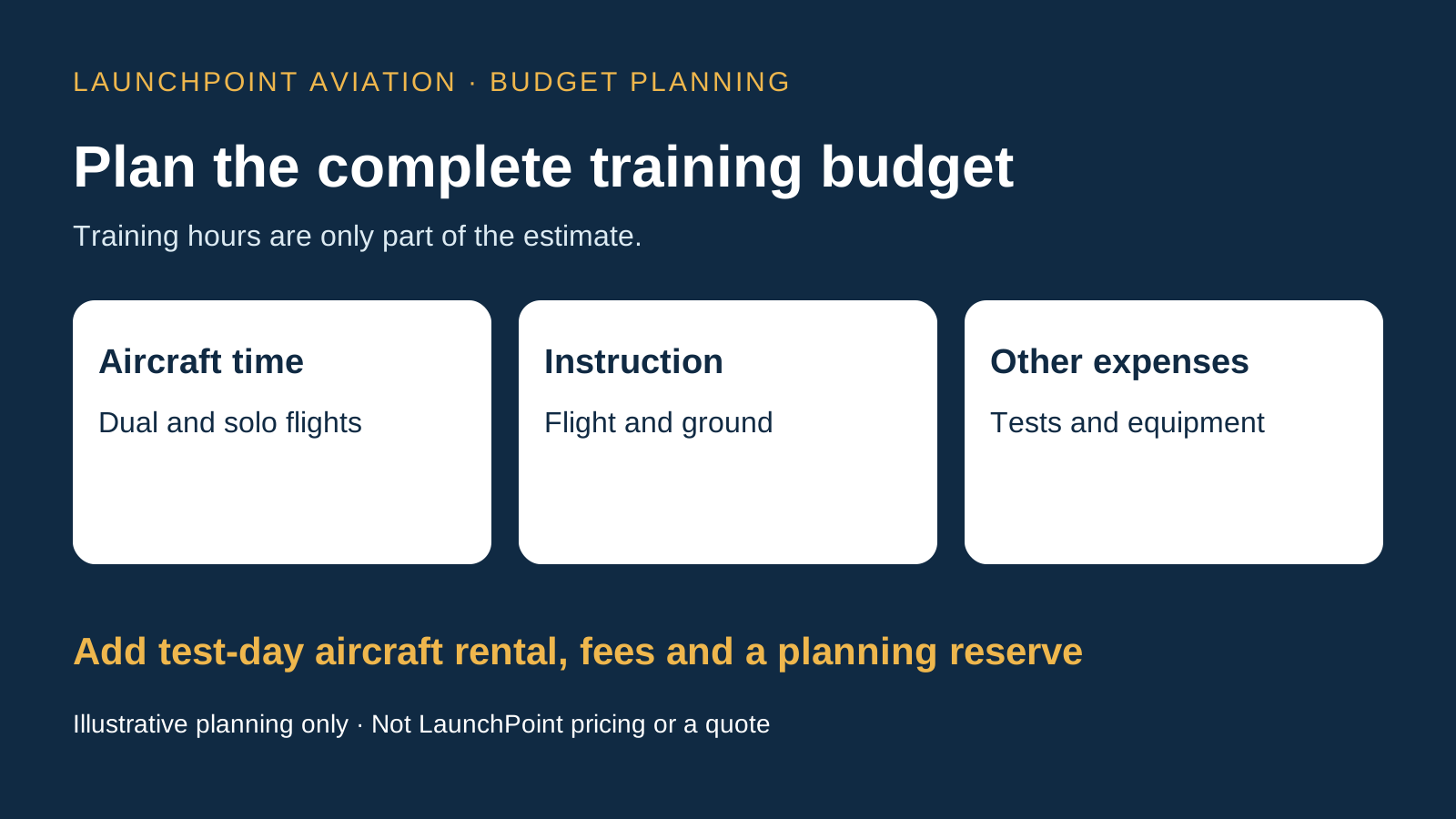
How much does it cost to get a private pilot license? The answer depends primarily on airplane rental rates, instructor charges, how many hours you need before the practical test, and expenses beyond flight time. A realistic plan should compare several completion-hour scenarios rather than multiply the FAA's minimum requirement by a single advertised hourly rate.
For illustration, using a $185-per-hour wet airplane rate, $65-per-hour instructor rate, and explicit allowances for tests, materials, and contingency, the complete sample budgets below range from approximately $13,455 at an unusually efficient 40-hour scenario to $24,432 at 75 hours. The 60-hour illustration is $19,550. These figures are calculations, not nationally measured averages, guaranteed completion prices, or LaunchPoint tuition.
The FAA calls the credential a private pilot certificate, although “private pilot license” is the term many people use when searching online. This article concerns the common airplane, single-engine land training pathway, not an airline-career package or a helicopter certificate.
Source and calculation checks: October 28, 2026. Prices and regulatory information can change; confirm current requirements and local school quotes before acting.
How many hours does a private pilot license require?
Under the usual 14 CFR § 61.109 Part 61 pathway for an airplane single-engine rating, an applicant must log at least 40 hours of flight time, including the specified dual and solo experience. Among the subrequirements are 20 hours of flight training with an authorized instructor and 10 hours of solo flight, plus required cross-country, night, instrument-reference, and practical-test preparation experience. The applicant must also meet knowledge, eligibility, proficiency, endorsement, and testing requirements.
A qualifying Part 141 approved private-pilot course may have a 35-hour minimum, subject to the approved syllabus and applicable requirements. That does not mean an ordinary student should budget for only 35 hours, or that all flight training sold by a Part 141 provider qualifies for that minimum.
The Federal Aviation Administration reports that many people need roughly 60–75 hours to earn a private-pilot certificate. That is why a minimum-hours advertisement should be treated as a floor—not as a reliable all-in price for everyone.
Private pilot license cost: three transparent budget scenarios
Here is a transparent planning model using one consistent hypothetical set of prices:
- Airplane: $185 per flight hour, wet (fuel included under the assumed rental terms).
- Instructor: $65 per billed hour, including dual-flight instruction and separately billed ground or briefing time.
- Additional expenses: an allowance for ground-study materials, the knowledge test, examiner and practical-test arrangements, equipment, and other items.
- Planning reserve: 15% of subtotal, added to help account for uncertainty; this is optional, not a fee collected by a school.
| Cost category | 40-hour floor scenario | 60-hour working scenario | 75-hour extended scenario |
|---|---|---|---|
| Aircraft hours × $185 | $7,400 | $11,100 | $13,875 |
| Billed instruction hours × $65 | 40 hr = $2,600 | 60 hr = $3,900 | 78 hr = $5,070 |
| Tests, examiner, materials and other allowance | $1,700 | $2,000 | $2,300 |
| Subtotal | $11,700 | $17,000 | $21,245 |
| Illustrative 15% reserve | $1,755 | $2,550 | $3,187 |
| Total planning figure | $13,455 | $19,550 | $24,432 |
What the instructor-hour assumptions mean: The 40-hour scenario uses 30 dual-flight hours and 10 separately billed ground or briefing hours; the remaining 10 aircraft hours are assumed solo. The 60-hour scenario uses 45 dual and 15 ground/briefing hours, with 15 solo airplane hours. The 75-hour scenario uses 58 dual and 20 ground/briefing hours, with 17 solo airplane hours. The 40-hour example presumes every required flight experience item has been satisfied and the pilot is genuinely proficient—an unusually efficient outcome, not a promise.
The nonflight allowance is not an itemized estimate of current DPE charges. It is a placeholder that must be replaced by actual written quotes; an examiner and airplane rental for the practical test may exceed a student's assumption. Rounding is to the nearest dollar. Airplane hours in this model are training hours; any separately billed practical-test airplane time must be accounted for in the nonflight allowance or added to the estimate.
These examples are intentionally illustrative rather than purported market statistics. At a particular school, aircraft rates may be much higher or lower, instructor fees may be billed differently, and aircraft rental may be charged dry. Get a quote that shows its own assumptions.
Replace the allowance with itemized quotes
The 60-hour illustration assigns $2,000 to nontraining-flight expenses. One possible allocation is $350 for ground-study materials, $200 for knowledge testing, $800 for the examiner, $200 for equipment, $80 for insurance, and $370 for two assumed hours of practical-test airplane rental at $185. These are hypothetical allowances chosen to show the arithmetic, not verified provider fees. An actual examiner charge, insurance premium or equipment purchase may exceed them.
The editable worksheet below uses that 60-hour scenario. Enter current written quotes, and include any additional practical-test rental, medical qualification expenses when applicable, taxes, travel or retesting. Those additional costs are not automatically included in the initial example. The 40- and 75-hour table allowances are separate hypothetical totals, not an assertion that all three students would have identical expenses.
Use the private-pilot budget worksheet.
What fees make up the total cost of a private pilot certificate?
1. Aircraft rental
For many students, airplane time is the largest expense. A Cessna 152, Cessna 172, Piper Warrior, or another suitable trainer may have a different rental price because of size, fuel use, avionics, equipment, insurance, and local operating costs. Ask whether the quoted rate is wet or dry, whether fuel surcharges apply, and how time is measured.
As one dated public example, EAS Flight Training in southwest Missouri listed certain Cessna 172 aircraft at $184–$194 per hour wet when reviewed in October 2026. That is a regional reference point, not a universal market rate or a quote from LaunchPoint. National readers should obtain rates from their own prospective school.
2. Instructor and ground-instruction charges
You may pay for the instructor during the flight and for classroom instruction, preflight briefings, postflight review, or supervised planning. Some schools package these items; others charge by the hour. The airplane's Hobbs time and the instructor's billable time need not be identical.
3. Ground school and the FAA knowledge test
Students need aeronautical knowledge in regulations, weather, airspace, performance, navigation, risk management, and other areas. They may prepare through classroom instruction, an online ground school, independent study with instructor support, or a combination. Ask what your selected program includes. Budget for the knowledge test and any retest if necessary.
4. The practical test and designated pilot examiner
Completing flight hours does not itself award a certificate. You must meet the prerequisites and pass the FAA practical test, generally including an oral evaluation and flight. Examiner charges vary; flight schools may also charge for the aircraft used in the test, instructor preparation, travel, or other related arrangements. Get the examiner fee and aircraft policy directly from the relevant parties.
5. Medical qualification and administrative items
Private-pilot applicants generally need an applicable FAA medical qualification for solo flight and exercise of privileges; BasicMed is a separate alternative only for those meeting its prerequisites and operational limitations. Do not assume a current driver's license alone authorizes ordinary private-pilot operations. Medical visits, required records, identification, and administrative costs are circumstances to discuss with appropriate professionals before budgeting.
6. Headset, study tools, and insurance
Some providers loan headsets; others expect you to supply one. Charts, subscriptions, an EFB, training materials, and renter's or non-owned-aircraft insurance may add cost. Do not assume every optional tool is essential on day one.
Part 61 versus Part 141: which is less expensive?
Part 61 training offers flexibility in the arrangement of instruction, while Part 141 involves an FAA-approved course and additional school requirements. Part 141's lower regulatory minimum for an approved private-pilot course does not automatically translate into a lower bill. Instructor availability, aircraft utilization, school policies, tuition or administration fees, student preparation, and time to proficiency matter more than the minimum-hours comparison alone.
Ask for two written quotations at the same expected completion-hour assumption, with an itemized list of inclusions. Comparing a 35-hour Part 141 headline with a 65-hour Part 61 projection is not an apples-to-apples comparison.
How can you lower your training cost without cutting corners?
Train consistently. If your schedule and finances allow, a recurring lesson cadence may limit time spent relearning prior material. Weather or maintenance can still disrupt any plan; do not fly when conditions or readiness are unsuitable.
Study before each lesson. Review the assigned knowledge, maneuvers, checklists, and procedures before arriving. A prepared student often uses paid aircraft time more productively.
Choose an aircraft that fits the task. More expensive avionics or performance may be valuable for some goals, but they are not universally required for initial proficiency. The airplane must still meet the lesson's requirements and the student's needs.
Ask how the school handles cancellations and downtime. An unavailable aircraft, instructor turnover, or long wait for the practical test can add review flights. Understand backup options and progress-record procedures.
Resist false economies. Do not sacrifice safety, proficiency, maintenance standards, or necessary instruction merely to hit a minimum advertised number of hours.
Could a sport pilot certificate cost less?
For someone primarily interested in recreational daytime flying with no more than one passenger, the sport-pilot path may deserve consideration. Under the common airplane pathway, sport pilot has a 20-hour regulatory flight-time minimum, compared with the usual 40-hour Part 61 private-pilot minimum. Certain eligible sport pilots may use a valid U.S. driver's license instead of an FAA medical certificate for specified daytime operations, subject to important exclusions and restrictions.
The FAA's MOSAIC changes expanded potential sport-pilot aircraft eligibility, but operating limits and aircraft-specific requirements still apply. Sport pilot is not equivalent to private pilot and does not automatically fit travelers who want multiple passengers, broad night or instrument privileges, or a professional aviation career.
Compare the actual privileges in our sport pilot versus private pilot guide, then use the sport-pilot certificate cost guide to develop a second budget. A lower regulatory minimum does not guarantee an affordable or available local sport-pilot training program.
A real-world Missouri reference point
For readers in the Ozarks, Ozarks Technical Community College publishes an approximate $17,686–$18,306 estimate for its Aviation Private Pilot Flight Training certificate program. Treat it as a specific program's published figure whose present inclusions and eligibility need confirmation, not as a statewide average or as a price for every private-pilot student. Individual Part 61 quotations may have a different scope entirely.
Our separate Springfield flying-lesson cost guide walks through the cost of one flight lesson and local budgeting questions.
Frequently asked questions about private pilot license cost
What is the cheapest possible private pilot license cost?
There is no defensible universal minimum price. A very efficient student in a lower-cost aircraft may finish with fewer expenses, but meeting the FAA minimum flight-hour requirement alone does not establish readiness or satisfy every requirement. Request an itemized quote based on realistic proficiency assumptions.
Can I get my private pilot license in 40 hours?
It is legally possible under the usual Part 61 airplane pathway if every applicable requirement is met and the applicant is proficient. The FAA reports many applicants require 60–75 hours, so the minimum is not a good default budgeting prediction.
Does a Part 141 flight school guarantee a cheaper license?
No. An approved course may use a 35-hour minimum, but the actual completion time, school charges, and program requirements determine the total. Ask what is included and whether your specific enrollment is within the approved course.
Is the checkride included in flight school tuition?
Not automatically. The examiner's fee, aircraft rental for the test, and associated preparation may be charged separately. Confirm each item with the school and examiner.
Is sport pilot cheaper than private pilot?
It can be for some applicants, but only when the certificate fits the intended operation and a suitable, insured training and examination pathway is available. Compare credible local total-cost budgets, not regulatory minimum hours alone.
Do I need to attend college to become a private pilot?
No. A qualifying private-pilot certificate can be pursued through appropriate flight training without enrolling in a college degree program. College aviation pathways are an option for certain educational and career goals.
Find your first step into aviation
A private-pilot certificate is a substantial investment of money, time, and attention. Before deciding on a school, compare sport versus private pilot privileges, request a complete written budget, and consider an introductory flying experience.
LaunchPoint Aviation currently offers discovery-flight inquiries at Springfield Downtown Airport (3DW) in Missouri, with pricing and arrangements confirmed individually. Its planned sport-pilot training program is not open for enrollment and has no announced tuition or training packages. Prospective recreational students may join the planned 2027 program's interest list for updates; doing so does not reserve a place or create a payment obligation.
Sources and further reading: FAA Pilot Schools Information; FAA Become a Pilot; FAA MOSAIC overview; EAS aircraft-rental page; Ozarks Tech Aviation Flight Technology. Regulatory summaries are general information and are not individualized advice.
PRIVATE-PILOT BUDGET WORKSHEET
Calculate your own private-pilot budget
Every starting amount is illustrative. These are not LaunchPoint rates, verified fees or a completion guarantee. The initial 60-hour scenario matches the article’s $19,550 example. Replace the figures with written quotes from your chosen provider.
The $185 wet aircraft rate and $65 instruction rate are modeling assumptions, not a quotation from EAS or another school. The source-linked regional prices in the article were checked October 28, 2026. All fee allowances below are hypothetical.
Formula and starting example
Subtotal = training aircraft hours × aircraft rate + dual-flight instructor hours × instructor rate + ground hours × ground rate + each separate fee allowance. Total = subtotal × (1 + reserve percent ÷ 100).
60 × $185 + 45 × $65 + 15 × $65 + $350 + $200 + $800 + $200 + $80 + $370 = $17,000. The 15% reserve adds $2,550, for $19,550.
What you need to check
- The initial 60 aircraft hours are training only: 45 dual and 15 solo. They do not include test-day rental. Do not add the same aircraft time twice.
- The $370 other-charge field initially assumes two test-day aircraft hours at $185. It is a separate editable amount, and does not automatically change when you change the training rate. Replace it with the actual test-day quote and add any other charges.
- Wet means fuel is assumed included. For dry rental, add fuel, oil and surcharges as appropriate.
- Medical qualification expenses where applicable, taxes, travel, lodging, financing, retests and extra proficiency flights are excluded unless you add them. The examiner, testing, equipment and insurance allowances may be insufficient for your situation.
- The worksheet performs arithmetic only. It does not establish compliance, eligibility, aircraft availability or the number of hours you will need.
Your entries are calculated in this browser and are not submitted or stored by the worksheet. To keep them, print or save the page. Obtain actual prices before committing funds.