
Sport pilot and private pilot are different FAA certificates built for different missions. For airplane applicants, sport pilot generally has a 20-hour regulatory flight-time minimum, permits no more than one passenger, and can offer many eligible daytime applicants a driver’s-license medical pathway. Private pilot generally has a 40-hour minimum, supports broader aircraft and passenger use, includes required night training, and ordinarily relies on an FAA medical certificate or BasicMed when its conditions are met.[1][2][3]
Neither path is universally better. Sport pilot may fit a person whose real objective is defined recreational flying in qualifying aircraft. Private pilot may fit someone who expects broader travel, more passengers, night operations without a sport-specific endorsement path, an instrument rating, or an aviation career. Cost and calendar time depend more on readiness, consistency, aircraft access, and local operations than on the minimum-hour numbers alone.
Accurate as of July 22, 2026.
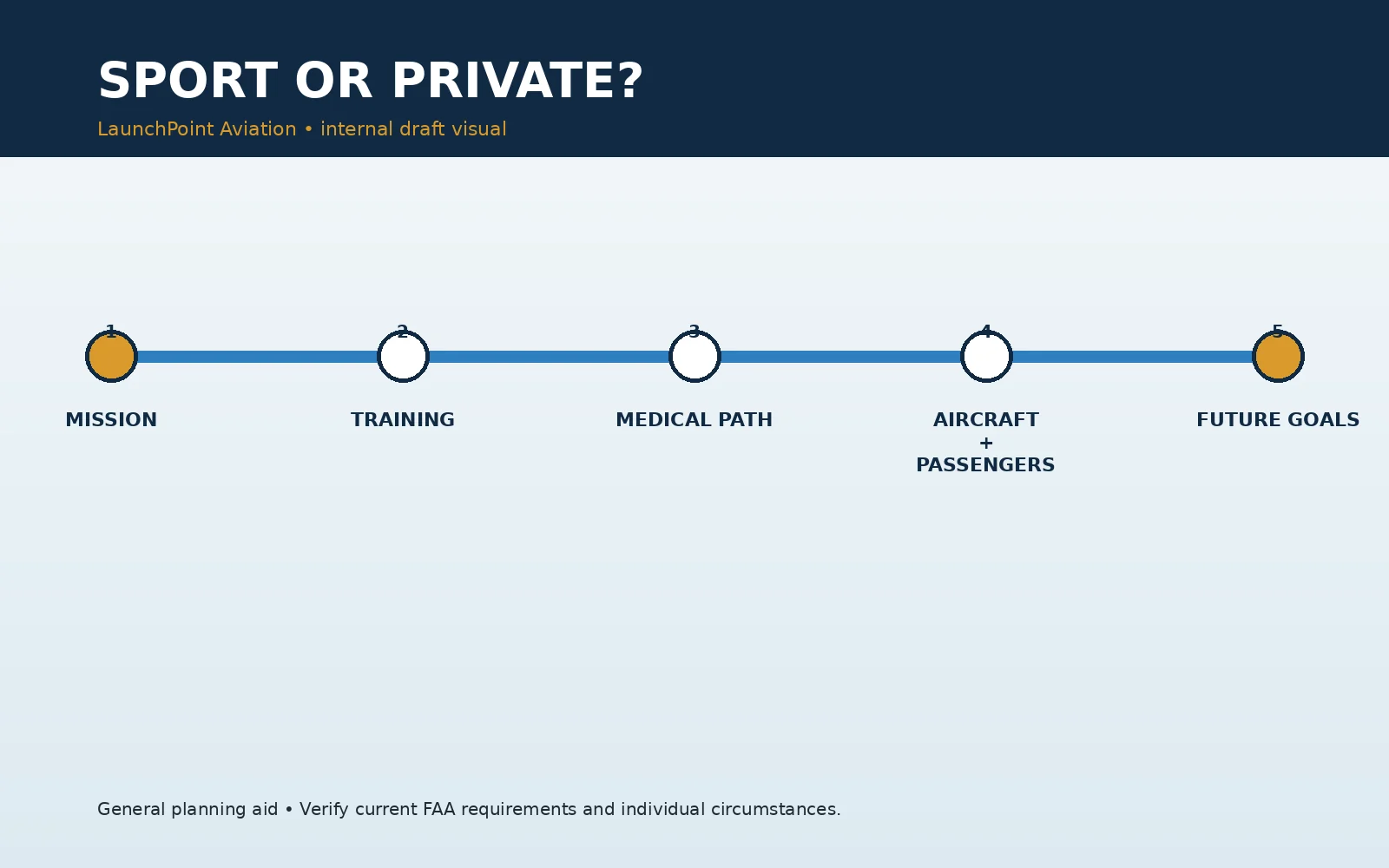
Table of contents
- Comparison at a glance
- Training requirements
- Medical pathways
- Aircraft and passengers
- Day, night, and airspace
- Travel and cost
- Career and upgrade paths
- Who may prefer each
- Frequently asked questions
Comparison at a glance
| Question | Sport-pilot certificate | Private-pilot certificate |
|---|---|---|
| Primary use | Defined personal and recreational flying | Broader noncommercial personal flying |
| Airplane minimum flight time | 20 hours meeting § 61.313 categories | 40 hours meeting § 61.109 categories |
| Passengers | No more than one | More than one when aircraft, loading, currency, and other rules permit |
| Medical pathway | Applicable FAA medical or conditional U.S. driver’s-license pathway for many daytime operations | Applicable FAA medical or BasicMed when eligible and operating within its conditions |
| Night | Possible only after § 61.329 training, endorsement, and added medical qualification | Included in airplane training requirements; pilot must remain qualified and current |
| Aircraft | Airplanes meeting § 61.316, with required endorsements | Aircraft matching category/class/type privileges and endorsements; broader envelope |
| Controlled airspace | Specific § 61.325 training and endorsement required for listed airspace and towered operations | Covered through private training, subject to airspace rules and any airport restrictions |
| Compensation/business | Sport limitations include no compensation/hire and no flight in furtherance of business | Still generally noncommercial, but § 61.113 contains broader, specific exceptions and limitations |
| Instrument rating | Not added to a sport-pilot certificate | May be added after meeting instrument-rating requirements |
| Career foundation | Training may contribute, but certificate itself is not a professional credential | Conventional foundation for instrument, commercial, and instructor progression |
The table describes common airplane paths. It does not replace the current regulations or an instructor’s review of an individual plan.
Training requirements
Sport pilot
For airplane single-engine privileges, § 61.313 generally requires at least 20 hours: 15 hours of instruction and 5 hours solo, plus specified cross-country training, full-stop landings, a 75-nautical-mile solo cross-country, and recent practical-test preparation.[1] The applicant must also receive the required knowledge training and endorsements, pass the FAA knowledge test, and pass the practical test.
The 20-hour figure is a floor. It does not represent an average or promise. A student may need additional time to become consistent in landings, navigation, weather decisions, emergency procedures, radio work, or aircraft control.
Private pilot
For airplane single-engine land privileges under the common Part 61 path, § 61.109 generally requires at least 40 hours, including 20 hours with an authorized instructor and 10 hours solo. The categories include night training, instrument-reference training, dual and solo cross-country experience, towered-airport landings, and recent practical-test preparation.[2]
A certificated Part 141 school may operate under an approved curriculum with different minimum structures. A prospective student should ask which regulatory part applies and obtain a written estimate based on the school’s actual syllabus.
The hours are not the whole difference
Private training covers additional experience because the certificate supports a broader mission. A sport student who trains in a capable post-MOSAIC airplane may learn many of the same fundamentals, but the applicable syllabus and checkride still target sport-pilot privileges and standards.
Training quality is not measured by how aggressively a school pushes toward the minimum. A strong program records progress, addresses weak areas, and refuses to recommend a checkride before the applicant is ready.
Medical pathways
For many eligible daytime sport-pilot operations, §§ 61.23 and 61.303 allow a current and valid U.S. driver’s license instead of an FAA medical certificate. Conditions concern prior FAA medical applications, suspension or revocation, special issuance, state-license restrictions, and present medical safety.[1][3]
Private-pilot operations that require medical qualification commonly use a third-class medical or BasicMed when the pilot meets the BasicMed prerequisites and operating conditions.[3][4] BasicMed is not the same as the sport driver’s-license pathway, and it generally depends on a qualifying prior FAA medical.
Neither certificate permits flight during medical deficiency. Section 61.53 requires pilots to refrain from operations when they know or have reason to know of a condition that would make safe operation impossible.[3]
Medical history can affect pathway choice. Do not make decisions about applying for, avoiding, withdrawing, or changing an FAA medical application based solely on a general article; consult current FAA sources and appropriate professional guidance.
Aircraft and passengers
Sport-pilot aircraft after MOSAIC
MOSAIC replaced the former light-sport-only boundary with the performance and design criteria in § 61.316.[1][5] A qualifying airplane may have up to four certificated seats, but the pilot may carry no more than one passenger. The airplane must satisfy the stall-speed, original-certification, seating, pressurization, type-rating, and other applicable criteria.
Higher VH, retractable landing gear, and a manually controllable-pitch propeller can require added training and endorsements. A model list is not enough; the particular aircraft and configuration need review.
Private-pilot aircraft
A private pilot may operate aircraft within the pilot’s category, class, and type privileges, subject to endorsements, ratings, aircraft limitations, medical pathway, currency, and operating rules. Aircraft requiring complex, high-performance, tailwheel, pressurized, or type-specific qualifications add requirements.
Private does not mean “any airplane.” It means the underlying certificate offers a broader framework from which additional qualifications can be earned.
Passengers
Sport pilot is limited to one passenger. Private pilot may carry more passengers when the aircraft, loading, seat belts, passenger-carrying currency, and all other rules permit. A private pilot still may not generally carry passengers for compensation or hire.
Day, night, and airspace
Day and night
Day visual-flight operations remain the straightforward sport mission. After MOSAIC, § 61.329 allows a sport pilot to earn night privileges through specified training and an instructor endorsement, with an additional medical condition: at least a third-class medical or the driver’s-license-plus-BasicMed route described in the rule.[1]
Private airplane training includes night experience under § 61.109.[2] After certification, the pilot must maintain the applicable recent experience to carry passengers at night and comply with all aircraft and operating requirements.
Controlled airspace
A sport pilot needs the § 61.325 training and endorsement to operate in Class B, C, or D airspace or at an airport with an operating control tower, subject to the rule’s scope.[1] Private-pilot training includes controlled-airspace knowledge and operations, but specific airports can still prohibit student, sport, or recreational operations, and pilots must comply with clearances and equipment rules.
Cross-country travel and cost
Both certificates can support cross-country recreation, but the mission envelopes differ. Consider:
- number of people traveling;
- day-only versus night flexibility;
- weather tolerance and the absence or presence of an instrument rating;
- aircraft payload and baggage;
- airport and airspace access;
- availability of qualifying rental aircraft away from home;
- international acceptance and authorization; and
- the need to complete a trip on a schedule.
A sport pilot can make meaningful trips within the certificate’s limits, but neither VFR certificate should be marketed as guaranteed transportation. Weather, proficiency, maintenance, runway conditions, and conservative decision-making can delay or cancel a flight.
Cost considerations
Sport pilot may cost less because the regulatory minimum is lower, but the total depends on actual hours and rates. A locally available qualifying airplane may be more or less expensive than a private trainer. A student who later upgrades may pay for additional night, instrument-reference, cross-country, and other private requirements.
Private pilot may cost more initially but better fit a mission that would otherwise require an immediate upgrade. The useful comparison is total cost to the desired privilege set—not a low advertised minimum multiplied by the cheapest hourly rate.
LaunchPoint Aviation has not announced rates or training packages.
Career and upgrade paths
A sport-pilot certificate is not a commercial or airline credential. A person seeking a professional path will typically need private pilot, instrument rating, commercial pilot, and other certificates, ratings, experience, and medical qualifications appropriate to the work.
A sport pilot can later pursue private pilot. Properly logged training and flight time may count when it satisfies the private requirements, but an instructor should audit the records. The applicant must complete any missing experience, knowledge, endorsements, medical qualification, and practical testing for private pilot.
Starting with sport can make sense when its privileges fit the person’s current mission. Starting with private can make sense when night, passengers, broader aircraft, or career progression are already clear goals. Neither choice should be made from embarrassment, status, or a claim that one certificate represents a “real” pilot. Both demand sound judgment and proficiency.
Who may prefer each path
Sport pilot may be worth exploring when
- the primary goal is personal daytime recreation;
- one passenger is enough;
- qualifying aircraft are reliably available;
- the driver’s-license pathway appears applicable after careful review;
- the person accepts the certificate’s operating limitations; and
- the school, instructor, and insurer genuinely support sport training and student solo.
Private pilot may be worth exploring when
- carrying more than one passenger matters;
- night flying is a routine goal;
- an instrument rating or career path is likely;
- broader aircraft or travel flexibility is important;
- the person can satisfy the applicable medical pathway; and
- the additional training and budget fit the plan.
Questions for an instructor
- Which certificate matches the trips I actually describe?
- What aircraft will I train and solo in, and why does it qualify?
- What is the school’s medical-pathway and insurance policy?
- How many recent students pursued this certificate?
- What completion range is realistic from the school’s own records?
- How would a later upgrade be documented and scheduled?
Frequently asked questions
Is sport pilot always cheaper than private pilot?
No. It has a lower airplane minimum, but total cost depends on actual training time, aircraft and instructor rates, availability, testing, equipment, and whether the student later adds private privileges.
Can sport-pilot flight time count toward private pilot?
Qualifying time may count, but the applicant must satisfy every private-pilot requirement. Have an instructor review the logbook before relying on a transfer assumption.
Can a sport pilot fly at night?
Potentially, after completing § 61.329 training, receiving the endorsement, and satisfying its additional medical qualification.[1]
Which certificate is better for an aviation career?
Private pilot is the conventional foundation for later instrument, commercial, and instructor progression. Sport training can contribute experience, but the sport certificate itself does not authorize commercial operations.
This article provides general aviation and regulatory information only. It does not determine any individual’s legal, medical, or operational eligibility to act as pilot in command. Readers should review current FAA materials and obtain appropriate individualized guidance when necessary.
Sources and further reading
[1] Electronic Code of Federal Regulations, “14 C.F.R. Part 61, Subpart J—Sport Pilots”. Reviewed 2026-07-22.
[2] Electronic Code of Federal Regulations, “14 C.F.R. Part 61, Subpart E—Private Pilots”. Reviewed 2026-07-22.
[3] Electronic Code of Federal Regulations, “14 C.F.R. § 61.23—Medical certificates”. Reviewed 2026-07-22.
[4] Federal Aviation Administration, “BasicMed”. Reviewed 2026-07-22. Published or updated 2026-06.
[5] Federal Aviation Administration, “Sport Pilot”. Reviewed 2026-07-22. Published or updated 2026-04-15.
The eCFR is continuously updated and is authoritative but unofficial.
Related LaunchPoint guides
- the complete sport-pilot requirements guide — Sport Pilot License Requirements: A Complete Current Guide
- the medical-pathway comparison — BasicMed, a Third-Class Medical, and Sport-Pilot Privileges Compared
- the sport-pilot budgeting guide — How Much Does a Sport Pilot Certificate Cost?
- the aircraft-eligibility guide — What Airplanes Can a Sport Pilot Fly After MOSAIC?
LaunchPoint pre-launch disclosure
LaunchPoint Aviation Group, LLC is currently developing a proposed sport-pilot training program for the Ozarks, with an anticipated launch in 2027. LaunchPoint is not presently offering flight instruction, aircraft rental, enrollment, scheduling, discovery flights, or paid aviation services. Program details, aircraft, instructors, airport location, pricing, and launch timing remain subject to change.
Corrections and updates
To report a possible error or suggest an update, contact admin@launchpointaviation.com with the article title, the passage in question, and a link to any supporting official source. Do not send medical records, diagnoses, government identifiers, or other sensitive personal information.
Stay informed
Interested in sport-pilot training in the Ozarks?
Join the LaunchPoint Aviation 2027 Interest List to receive occasional development updates and be notified when enrollment information becomes available.
Joining the interest list is not enrollment, does not reserve a position, and creates no payment obligation.