
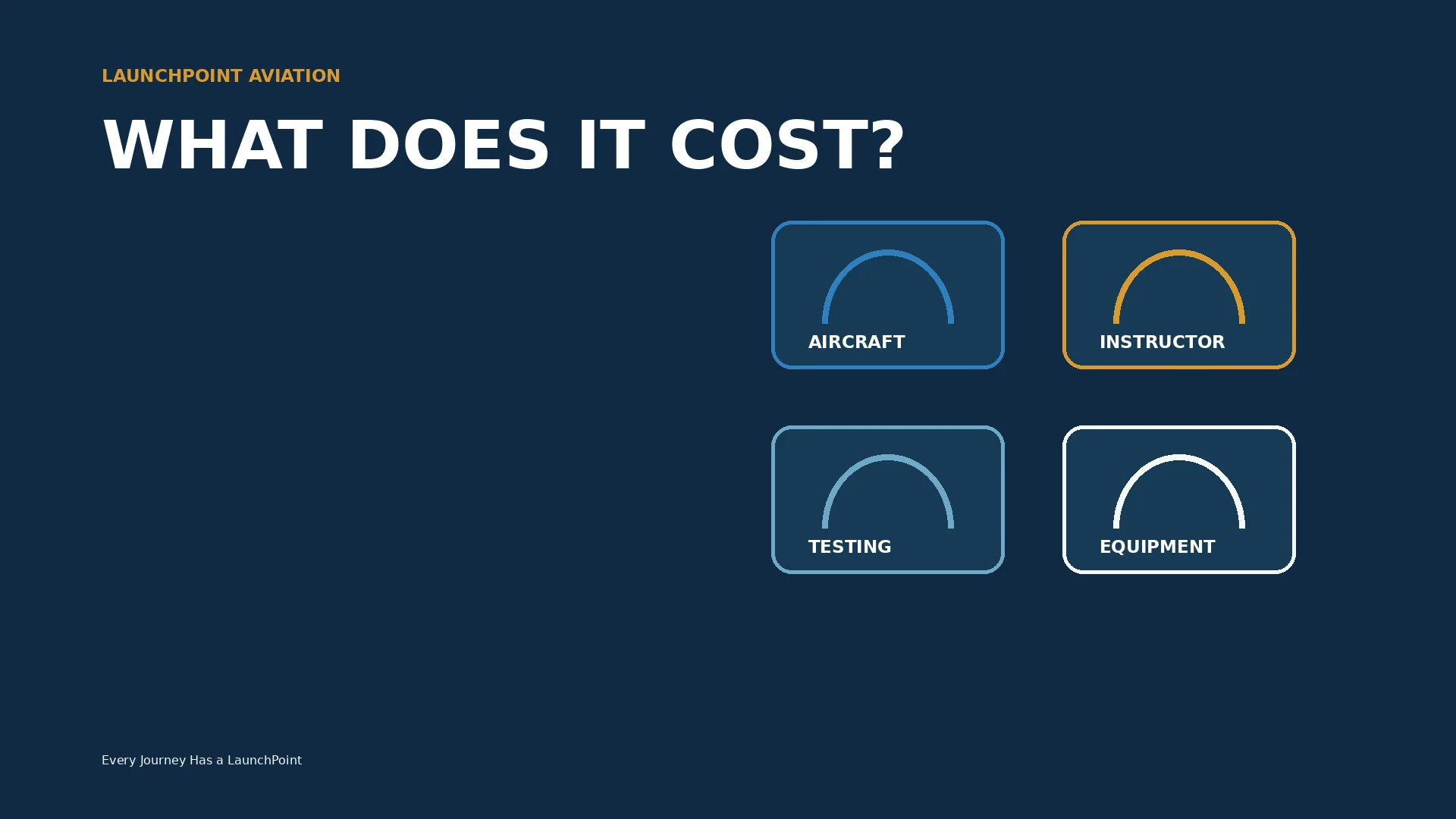
There is no universal price for a sport-pilot certificate. A realistic 2026 planning range for airplane training is often built from approximately $140–$200 per aircraft hour, $55–$90 per instructor hour, actual dual and solo time, ground instruction, testing, equipment, insurance, and a contingency for training beyond the 20-hour regulatory minimum. Using those inputs, illustrative complete budgets can extend from roughly $6,000 at an unusually efficient minimum-based scenario to $16,000 or more when 35–45 hours, added ground instruction, delays, or higher local rates are involved.[1][3][4][5]
These are illustrative planning estimates, not LaunchPoint prices or quotes. LaunchPoint Aviation has not announced rates or training packages. A student should obtain a written local estimate showing hours, wet or dry aircraft rates, instructor time, test and examiner costs, supplies, taxes, surcharges, refund terms, and assumptions.
Accurate as of July 22, 2026.
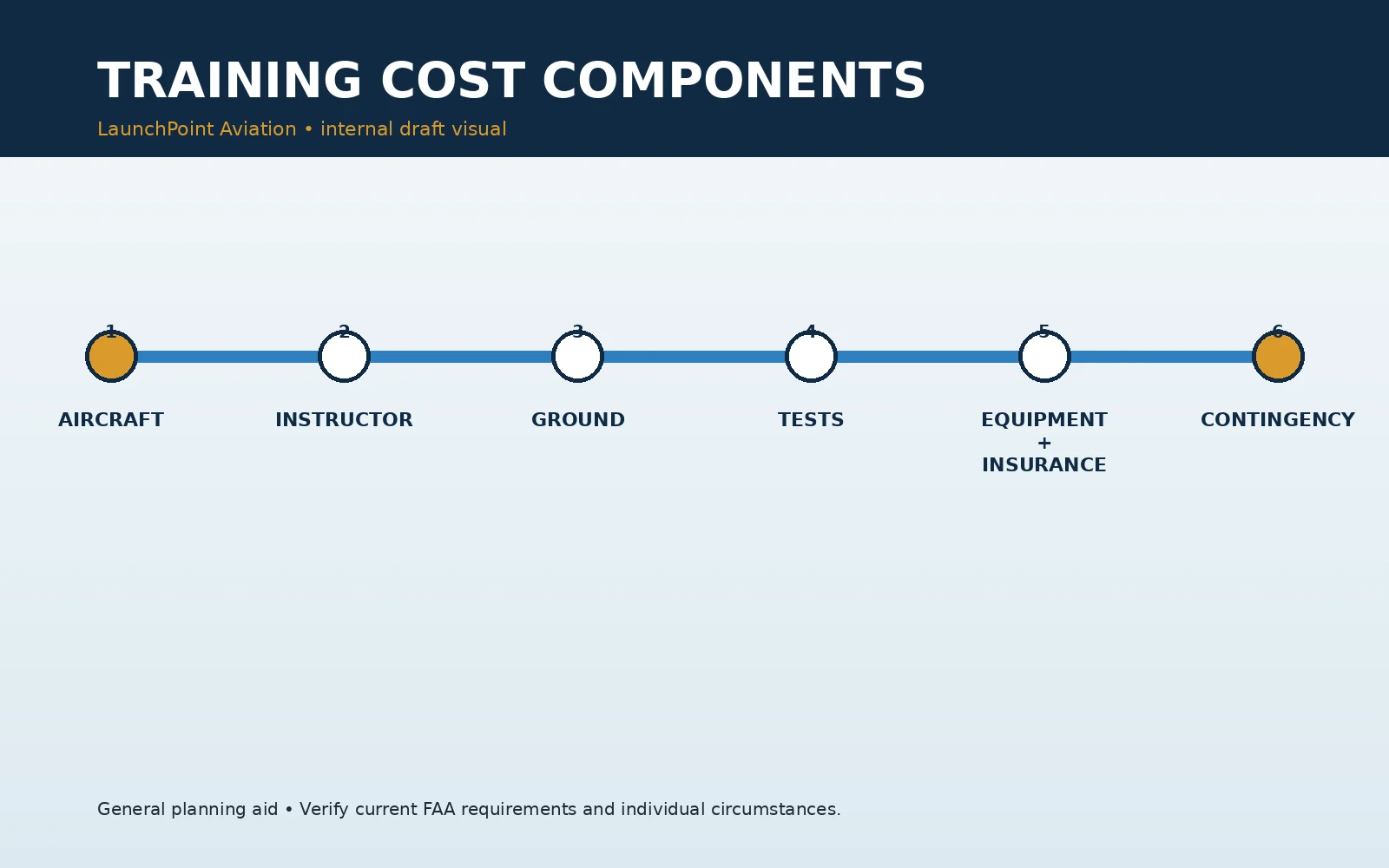
Table of contents
- A defensible cost formula
- Aircraft and instructor charges
- Ground training and tests
- Equipment and insurance
- Why totals change
- Missouri and Ozarks context
- Illustrative budgets
- Controlling cost responsibly
- Frequently asked questions
A defensible cost formula
Use a worksheet rather than one advertised package number:
Aircraft time × aircraft rate
+ dual instruction time × instructor rate
+ ground instruction or course cost
+ knowledge test and practical test
+ equipment, materials, insurance, taxes, and surcharges
+ contingency for additional training
The regulation establishes a minimum set of experience categories; it does not set prices or an average completion time. For airplane single-engine privileges, § 61.313 generally requires 20 total hours, including 15 with an instructor and 5 solo, plus specified cross-country, landing, and recent-test-preparation experience.[1]
If a student is not ready after the minimum, more training is required. A budget that includes no contingency converts a legal floor into a financial promise.
Aircraft rental and instructor charges
Aircraft rate
Training airplanes are commonly billed using a recording meter such as Hobbs time or tach time. Ask which. A rate may be:
- Wet: fuel and oil are included under the provider’s policy.
- Dry: fuel is separate.
- Wet with surcharge: a base rate includes fuel but adds a variable fuel adjustment.
In public examples reviewed in July 2026, the University of Central Missouri lists wet airplane rates from $119 for a PA-18 to $166–$187 for Cessna 172 variants, with instruction at $55 per hour.[3] A current California provider lists two-seat trainers at $100 and 172 variants around $150–$170, with primary instruction at $75.[5] These examples demonstrate the range and billing components; they are not sport-pilot promises, southwest Missouri quotes, or LaunchPoint prices.
For planning, a $140–$200 hourly aircraft band is a reasonable placeholder for many conventional trainers in 2026, but actual qualifying aircraft may fall outside it. Verify whether taxes, fuel adjustments, minimum daily hours, overnight charges, and renter’s insurance are extra.
Instructor rate
Instruction may be billed for flight time, briefing, debriefing, ground lessons, simulator time, and waiting caused by student preparation. Rates in reviewed public examples fall around $55–$75 per hour, while $90 or more may occur in some markets or for specialized instruction.[3][5]
Ask whether the instructor is an employee or independent contractor, whether the same rate applies to ground and flight, and whether cancellation or no-show fees apply. A lower hourly rate does not save money if the student repeatedly changes instructors or receives little structured feedback.
Ground training, knowledge test, and practical test
Ground knowledge
Ground training can be instructor-led, classroom-based, online, self-study, or mixed. An online course may cost less than individual instruction, but a student should budget instructor time to answer questions, connect knowledge to the local aircraft, and receive required endorsements.
A planning range might include several hundred dollars for a course and materials, or 10–25 hours of individual ground instruction at the local rate. The right amount depends on prior experience and study discipline. Avoid a budget that assumes an applicant can buy a course, pass a quiz, and need no instructor review.
Knowledge test
The FAA authorizes testing providers and publishes testing information, but the fee charged to the applicant can change.[2] Confirm the current Sport Pilot Airplane test, authorization, identification rules, testing location, retest terms, and fee directly with the current provider before scheduling.
Practical test
Designated pilot examiners generally charge for their time, and there is no single national retail price guaranteed by the FAA. Fees vary by region, evaluator, travel, aircraft, and retest scope. Obtain the quote and cancellation policy in writing. Also budget the aircraft for the test and any repositioning or instructor travel.
A low package price that excludes the evaluator and checkride aircraft can understate the finish-line cost materially.
Supplies, equipment, and insurance
A complete budget may include:
- headset purchase or rental;
- logbook or electronic logbook;
- current charts and navigation tools;
- plotter, flight computer, kneeboard, flashlight, and view-limiting device where appropriate;
- online ground course or textbooks;
- knowledge-test fee;
- examiner fee and checkride aircraft time;
- renter’s or non-owned-aircraft insurance;
- sales tax, fuel surcharges, and card fees;
- medical examination or BasicMed-related physician cost, if that pathway is used;
- travel to a testing center or examiner; and
- replacement lessons after weather, maintenance, or a long break.
Not every school requires the same equipment. Buy after confirming the syllabus and aircraft. An expensive tablet and subscription are not substitutes for understanding navigation and aircraft systems.
Factors that change total cost
Actual hours to proficiency
This is usually the largest variable. Learning pace, consistency, weather, aircraft availability, instructor continuity, airport traffic, and study preparation all affect it.
Dual-to-solo mix
Aircraft is billed for both, while instructor charges usually apply to dual flight and ground time. A student may legally have five solo hours yet need additional dual work for proficiency. The training plan should never favor solo simply because it is cheaper if the instructor has not determined the student is safe and properly endorsed.
Aircraft type and availability
A lower-cost airplane that is frequently unavailable can generate relearning. A slightly higher rate with reliable dispatch may reduce total hours. Conversely, a sophisticated cockpit may increase rental cost without adding value to an initial recreational goal.
Frequency
Long gaps often require review. A sustainable two-or-three-times-per-week schedule can improve retention for some students, but a schedule that creates fatigue or financial stress can be counterproductive.
Weather and airport environment
Spring thunderstorms, winter ceilings, high winds, heat, and dense traffic can interrupt lessons. Some delays are valuable demonstrations of sound decision-making. A cost estimate should assume that not every reserved slot becomes a completed flight.
Examiner access
Limited designated pilot examiner availability can extend the calendar and create additional proficiency flights before the test. Ask how the school plans for examiner scheduling and whether the quoted budget includes maintaining readiness.
Missouri and Ozarks considerations
Southwest Missouri combines public-use airports, varied terrain, seasonal weather, and both towered and nontowered environments. The right airport is not automatically the nearest or largest. Taxi time, airspace, runway configuration, practice-area transit, fuel pricing, maintenance access, and weather alternatives affect both cost and training value.
The National Weather Service’s Springfield normals show meaningful seasonal variation in precipitation and temperature.[4] Normals do not predict an individual lesson, but they support a budget that expects weather rescheduling rather than treating every cancellation as a failure.
Regional educational programs provide useful context. Ozarks Technical Community College currently publishes a much broader private-pilot flight-training program estimate, not a sport-pilot quote.[6] Its presence also indicates that local search demand includes career and private pathways, so a prospective sport student should ask directly whether a provider supports the sport certificate and intended medical pathway.
LaunchPoint’s proposed operation is still evaluating aircraft, insurance, airport arrangements, instructors, maintenance support, curriculum, and operating systems. Those decisions must be completed before pricing can be responsibly announced.
Illustrative budget scenarios
The following 2026 examples are arithmetic models, not market quotes or promises. They assume a qualifying conventional trainer and use broad rate ranges.
| Component | Minimum-based illustration | 30-hour planning case | 40-hour planning case |
|---|---|---|---|
| Aircraft | 20 × $140–$180 = $2,800–$3,600 | 30 × $150–$190 = $4,500–$5,700 | 40 × $150–$200 = $6,000–$8,000 |
| Instructor flight/briefing | 17–20 × $55–$80 = $935–$1,600 | 22–28 × $60–$85 = $1,320–$2,380 | 28–36 × $60–$90 = $1,680–$3,240 |
| Ground/course | $350–$1,200 | $500–$1,700 | $600–$2,200 |
| Tests, examiner, equipment, insurance, contingency | $1,400–$3,000 | $1,700–$3,500 | $2,000–$4,000 |
| Illustrative total | $5,485–$9,400 | $8,020–$13,280 | $10,280–$17,440 |
The 20-hour scenario illustrates the regulatory minimum; it is not a likely training package or price quote. Obtain a current written estimate showing the school’s local rates, assumptions, and refund terms.
How consistent training can affect cost
Cost control should support safety and learning:
- Arrive having completed assigned reading and weather review.
- Use a written syllabus and know the lesson objective.
- Schedule at a sustainable frequency.
- Chair-fly checklists and procedures between lessons.
- Debrief in writing and address weak areas promptly.
- Avoid long prepaid balances unless refund and insolvency protections are clear.
- Track aircraft, instructor, ground, and incidental spending separately.
- Ask for a progress and budget review at defined milestones.
- Preserve flexibility for weather and maintenance.
- Do not pressure an instructor to endorse solo or a checkride to meet a budget.
Frequently asked questions
Can I finish at the 20-hour minimum?
It is legally possible if every experience category is satisfied and the applicant is ready, but it is not guaranteed or necessarily typical. Budget beyond the floor.[1]
Are aircraft rates usually wet or dry?
Both exist. Confirm fuel, oil, taxes, surcharges, minimums, and the billing meter in writing.
Does the checkride have a fixed national fee?
No single retail amount applies everywhere. Confirm the evaluator’s current fee, travel, cancellation, retest, and payment terms.
Has LaunchPoint announced pricing?
No. LaunchPoint Aviation has not announced rates or training packages. Any figures in this article are general planning examples from public 2026 inputs and are not LaunchPoint prices.
This article provides general aviation and regulatory information only. It does not determine any individual’s legal, medical, or operational eligibility to act as pilot in command. Readers should review current FAA materials and obtain appropriate individualized guidance when necessary.
Sources and further reading
[1] Electronic Code of Federal Regulations, “14 C.F.R. Part 61, Subpart J—Sport Pilots”. Reviewed 2026-07-22.
[2] Federal Aviation Administration, “Airman Testing”. Reviewed 2026-07-22. Published or updated 2026-07-01.
[3] University of Central Missouri, “UCM Flight Fee Schedule”. Reviewed 2026-07-22. Published or updated 2026-01-12.
[4] National Weather Service Springfield, “Springfield, Missouri Monthly Climate Normals”. Reviewed 2026-07-22. Published or updated 1991–2020 normals.
[5] EFI Flight School, “published aircraft and instruction rate page”. Reviewed 2026-07-22. Published or updated 2026-07-03.
[6] Ozarks Technical Community College, “Aviation Flight Technology Program Costs”. Reviewed 2026-07-22. Published or updated Current page.
The eCFR is continuously updated and is authoritative but unofficial.
Related LaunchPoint guides
- the complete sport-pilot requirements guide — Sport Pilot License Requirements: A Complete Current Guide
- the sport-versus-private comparison — Sport Pilot Versus Private Pilot: Which Path Fits Your Goals?
- the flight-school selection checklist — How to Choose a Sport-Pilot Flight School
- the Missouri and Ozarks training guide — Sport-Pilot Training in Missouri and the Ozarks
LaunchPoint pre-launch disclosure
LaunchPoint Aviation Group, LLC is currently developing a proposed sport-pilot training program for the Ozarks, with an anticipated launch in 2027. LaunchPoint is not presently offering flight instruction, aircraft rental, enrollment, scheduling, discovery flights, or paid aviation services. Program details, aircraft, instructors, airport location, pricing, and launch timing remain subject to change.
Corrections and updates
To report a possible error or suggest an update, contact admin@launchpointaviation.com with the article title, the passage in question, and a link to any supporting official source. Do not send medical records, diagnoses, government identifiers, or other sensitive personal information.
Stay informed
Interested in sport-pilot training in the Ozarks?
Join the LaunchPoint Aviation 2027 Interest List to receive occasional development updates and be notified when enrollment information becomes available.
Joining the interest list is not enrollment, does not reserve a position, and creates no payment obligation.