
A suitable sport-pilot flight school must do more than offer general flight instruction. Before committing money, confirm that the school actually supports the sport-pilot certificate, can document that the training airplane qualifies under current § 61.316, permits the intended medical pathway under its insurance and solo policies, and has qualified instructors, a written syllabus, maintenance capacity, scheduling access, transparent pricing, and a realistic designated pilot examiner plan.[2][3]
The lowest hourly rate is not automatically the lowest total cost. Aircraft downtime, instructor turnover, long booking delays, unclear lesson records, or a missing checkride plan can add hours and months. Use the checklist below to compare providers on evidence. LaunchPoint Aviation is itself pre-operational; this article states the standards its planned program should satisfy and does not claim that LaunchPoint currently offers any training.
Accurate as of July 22, 2026.
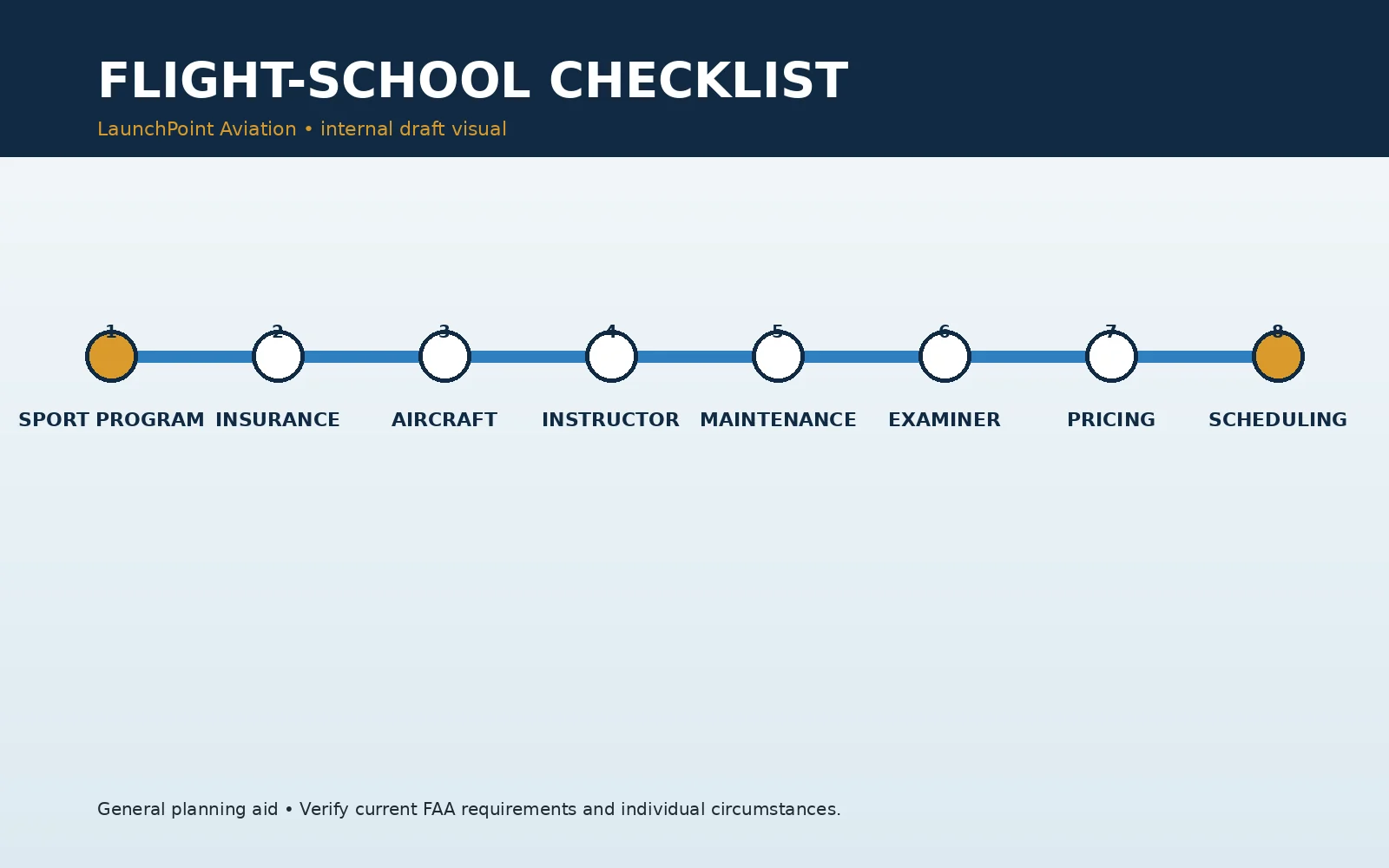
Table of contents
- Confirm sport-pilot support
- Medical pathway and insurance
- Aircraft and maintenance
- Instructor and syllabus
- Stage checks and policies
- Examiner, pricing, and scheduling
- Questions and red flags
- Printable checklist
- Frequently asked questions
Verify that the school really supports sport pilot
Ask the direct question: “Are you currently accepting applicants for an airplane sport-pilot certificate, and can a new student complete dual, solo, and the practical test in your program?”
Possible answers need follow-up:
- “We can teach you in any airplane now because of MOSAIC.” Ask for the exact-aircraft § 61.316 review and endorsement plan.
- “We teach sport-pilot students.” Ask whether insurance and owner policy cover student solo and checkride use.
- “You can train private and take a sport checkride.” Ask for the written syllabus mapping training and records to the sport requirements.
- “We have a qualifying airplane.” Ask about dispatch history, backup capacity, and examiner acceptance.
FAA regulations define certificate requirements; the FAA does not “approve” an ordinary Part 61 provider’s marketing claim as a sport-pilot school. Avoid a provider that uses the FAA seal or says “FAA-approved as a school” without accurately describing a specific certification status.
Driver’s-license solo policy and insurance
For many eligible daytime sport applicants, a current and valid U.S. driver’s license may satisfy the applicable medical-document rule, subject to prior FAA medical history, state-license restrictions, and fitness-to-fly duties.[2] That federal path does not compel a school or insurer to allow student solo.
Ask in writing:
- Does the policy cover primary sport-pilot training?
- Does it cover a student relying on the driver’s-license pathway for solo?
- Are there age, hours, instructor-qualification, or named-pilot conditions?
- Is solo cross-country covered?
- Is the practical test covered with the planned examiner aboard?
- What renter’s or non-owned-aircraft policy must the student carry?
- Are night, crosswind, runway, or airport limits narrower than federal rules?
The school should explain policy without asking an applicant to email medical details. Do not submit diagnoses, medication lists, FAA medical correspondence, or driver’s-license numbers through an ordinary inquiry form.
Aircraft suitability, maintenance, and dispatch
Eligibility
Post-MOSAIC airplane eligibility turns on performance and design criteria, not a marketing name. The school should preserve a dated review showing the exact airplane’s approved VS1 data, seating, pressurization status, type-rating status, original certification, alterations, VH, and applicable endorsements.[3]
If a provider uses a four-seat trainer, confirm that its operating policy enforces the sport pilot’s one-passenger limit. If it uses retractable gear, a manually controllable-pitch propeller, or a higher-VH airplane, ask where the required training and endorsements appear in the syllabus.
Student fit
A qualifying airplane is not automatically suitable for every student. Instructor and student weight, fuel, baggage, center of gravity, cabin access, rudder-pedal reach, visibility, control forces, and temperature matter. The school should conduct weight-and-balance and fit evaluations without collecting unnecessary sensitive information.
Maintenance
Ask:
- Who performs routine and unscheduled maintenance?
- Is qualified support available locally?
- What was the airplane’s dispatch availability over the last 90 days?
- What recurring discrepancies have affected training?
- How are squawks reported, assessed, deferred, and communicated?
- Is a backup airplane available and also approved for the student’s stage?
- What happens to prepaid funds during extended downtime?
Students need not inspect private maintenance records without authorization, but a provider should describe its process confidently and never pressure a student to accept an aircraft the student believes is unsafe.
Instructor experience and written syllabus
An instructor does not need decades of experience to be effective. The important evidence is current knowledge, preparation, consistency, communication, judgment, and supervision.
Instructor questions
- Which instructor certificate and privileges authorize this training?
- How recently have you reviewed Subpart J, AC 61-146, and AC 61-65K?
- Have you prepared an applicant for a sport-pilot airplane practical test under current rules?
- How do you teach the driver’s-license pathway without giving medical advice?
- How do you document progress and transfer a student to another instructor?
- What is your expected availability for the next six months?
Written syllabus
A sport syllabus should map lessons to:
- § 61.309 knowledge areas;
- § 61.311 flight proficiency;
- § 61.313 aeronautical experience;
- § 61.87 and § 61.93 student solo requirements;
- applicable VH, airspace, gear, propeller, and night endorsements;
- knowledge-test preparation and deficiency review;
- current practical-test standards; and
- scenario-based judgment, weather, maintenance, and personal minimums.
“We train until you are ready” can be honest, but it is not a substitute for a documented course structure and progress checkpoints.
Stage checks, weather, and solo policies
Stage checks
An independent or second-instructor review before solo, before solo cross-country, and before the practical test can identify gaps. It should support the primary instructor rather than turn into an unexplained second syllabus.
Ask what happens if the stage check finds a deficiency, who pays for retraining, and how the result is documented.
Weather policy
The provider should have written minimums or a clear process for ceiling, visibility, surface wind, crosswind, gusts, thunderstorms, temperature, runway condition, and daylight. Student limitations can be more conservative than certificate-holder limits.
Good policy allows the student and instructor to cancel for safety without sales pressure. Ask when a cancellation fee applies and whether a ground lesson can replace the flight.
Solo policy
Solo authority is individual and conditional. Ask how the school controls:
- current 90-day endorsements;
- daily instructor authorization;
- aircraft dispatch and fuel;
- weather and crosswind limits;
- local practice areas and route tracking;
- flight following or check-in procedures;
- overdue aircraft response; and
- postflight discrepancies.
No provider should promise solo by a fixed hour.
Examiner, pricing, and scheduling
Examiner availability
Ask which designated pilot examiners currently accept sport-pilot airplane tests in the training aircraft.[4] Confirm their likely lead time, travel, fee, cancellation policy, aircraft expectations, and retest terms. A provider should avoid implying that an examiner guarantees a pass.
Pricing transparency
A written estimate should show:
- hourly aircraft rate and whether it is wet or dry;
- billing meter and minimum charges;
- instructor flight, briefing, and ground rates;
- fuel surcharges, taxes, and card fees;
- course, supplies, test, and insurance estimates;
- examiner and checkride-aircraft costs;
- expected training-hour range and assumptions;
- contingency for extra training; and
- deposit, balance, refund, and account-statement terms.
Avoid comparing only aircraft rates. A $10-per-hour difference is smaller than the cost of repeated relearning after maintenance or scheduling gaps.
Scheduling
Ask to see realistic availability, not the ideal capacity described in a brochure:
- How far ahead are aircraft and instructors booked?
- Can the student reserve recurring times?
- Are evenings and weekends genuinely staffed?
- How are maintenance blocks placed on the schedule?
- What happens when the assigned instructor leaves?
- Is another qualifying airplane available without a major transition?
Questions to ask and red flags
Questions to ask
- Can I complete the entire sport certificate here, including solo and checkride?
- Show me the written aircraft-eligibility determination.
- Show me the sport syllabus and stage checks.
- Explain the insurance and driver’s-license solo policy.
- What is the aircraft’s recent dispatch availability?
- Which examiner supports the aircraft, and what is the lead time?
- What does a realistic total budget include and exclude?
- How do I receive my records and unused account balance if I leave?
- How are safety concerns and maintenance discrepancies reported?
- What would cause the school to delay my solo or checkride?
Red flags
- “Guaranteed certificate” or “guaranteed 20-hour completion.”
- “an FAA medical is never required” without conditions.
- More than one passenger portrayed as a sport privilege.
- A four-seat model declared eligible without calibrated data or original-certification review.
- No written syllabus or progress records.
- Pressure to prepay a large nonrefundable balance.
- Unclear insurance for driver’s-license-only solo.
- No identified examiner path.
- Chronic maintenance cancellations with no disclosure or backup.
- Pressure to fly in weather or an aircraft that concerns the student.
- Claims of FAA endorsement, exclusivity, or a promised fixed opening date.
Printable school-selection checklist
Score each item confirmed, needs clarification, or not acceptable.
Program
- [ ] Provider currently accepts airplane sport-pilot applicants
- [ ] Dual, solo, cross-country, and checkride path confirmed
- [ ] Written sport-pilot syllabus provided
- [ ] Current practical-test standard identified
Aircraft and maintenance
- [ ] Particular airplane documented under § 61.316
- [ ] VS1, original certification, alterations, and VH reviewed
- [ ] Student fit and weight-and-balance process explained
- [ ] Recent dispatch history reviewed
- [ ] Local maintenance support and backup plan explained
Instructor and records
- [ ] Instructor privileges and current sport knowledge confirmed
- [ ] Progress records and stage checks explained
- [ ] Instructor-continuity plan explained
- [ ] Student can obtain complete records promptly
Insurance and solo
- [ ] Primary sport training covered
- [ ] Intended medical pathway accepted for student solo
- [ ] Renter’s insurance requirement stated
- [ ] Written weather, airport, crosswind, and solo policies supplied
Cost and schedule
- [ ] Wet/dry rate and billing meter stated
- [ ] Ground, briefing, test, examiner, equipment, taxes, and fees shown
- [ ] Refund and account-balance terms written
- [ ] Recurring schedule availability verified
- [ ] Maintenance and weather cancellation treatment clear
Practical test
- [ ] Examiner identified as currently accepting sport-airplane tests
- [ ] Aircraft acceptance, fee, travel, cancellation, and retest terms checked
- [ ] Records audit occurs well before scheduling
A separate print-ready HTML checklist is included with this article package.
Frequently asked questions
Can any flight school train a sport-pilot student?
An appropriately authorized instructor may provide qualifying training, but the complete program also needs a qualifying aircraft, lawful student-solo path, insurance, records, and a practical-test solution.
Why does the school’s insurance policy matter?
Insurance can restrict student solo, medical pathways, instructor qualifications, aircraft use, cross-country, or testing more narrowly than federal rules. Confirm coverage before relying on the program.
Should I prepay a large training balance?
Large prepayments create financial risk. If considering one, review refund timing, account statements, ownership of funds, maintenance downtime, insolvency protection, and any credit-card safeguards.
What is a strong maintenance question to ask?
Ask for the training aircraft’s dispatch availability over the last 90 days and how the provider handled cancellations, discrepancies, backup aircraft, and student balances. It invites evidence rather than a slogan.
This article provides general aviation and regulatory information only. It does not determine any individual’s legal, medical, or operational eligibility to act as pilot in command. Readers should review current FAA materials and obtain appropriate individualized guidance when necessary.
Sources and further reading
[1] Federal Aviation Administration, “Pilot Schools and Training”. Reviewed 2026-07-22. Published or updated 2026-06.
[2] Federal Aviation Administration, “Sport Pilot”. Reviewed 2026-07-22. Published or updated 2026-04-15.
[3] Electronic Code of Federal Regulations, “14 C.F.R. Part 61, Subpart J—Sport Pilots”. Reviewed 2026-07-22.
[4] Federal Aviation Administration, “Find a Designee”. Reviewed 2026-07-22.
[5] Experimental Aircraft Association, “Sport Pilot Instruction Overview”. Reviewed 2026-07-22. Published or updated Current page.
The eCFR is continuously updated and is authoritative but unofficial.
Related LaunchPoint guides
- the Missouri and Ozarks training guide — Sport-Pilot Training in Missouri and the Ozarks
- the complete sport-pilot requirements guide — Sport Pilot License Requirements: A Complete Current Guide
- the sport-pilot budgeting guide — How Much Does a Sport Pilot Certificate Cost?
- the aircraft-eligibility guide — What Airplanes Can a Sport Pilot Fly After MOSAIC?
LaunchPoint pre-launch disclosure
LaunchPoint Aviation Group, LLC is currently developing a proposed sport-pilot training program for the Ozarks, with an anticipated launch in 2027. LaunchPoint is not presently offering flight instruction, aircraft rental, enrollment, scheduling, discovery flights, or paid aviation services. Program details, aircraft, instructors, airport location, pricing, and launch timing remain subject to change.
Corrections and updates
To report a possible error or suggest an update, contact admin@launchpointaviation.com with the article title, the passage in question, and a link to any supporting official source. Do not send medical records, diagnoses, government identifiers, or other sensitive personal information.
Stay informed
Interested in sport-pilot training in the Ozarks?
Join the LaunchPoint Aviation 2027 Interest List to receive occasional development updates and be notified when enrollment information becomes available.
Joining the interest list is not enrollment, does not reserve a position, and creates no payment obligation.