
After MOSAIC, a sport pilot is no longer restricted to aircraft that fit the former federal definition of a light-sport aircraft. Instead, the particular airplane must meet the performance and design requirements in 14 C.F.R. § 61.316, and the pilot must hold the necessary category, class, and operating endorsements.[1][2] For airplanes, the core criteria include a VS1 stall speed of no more than 59 KCAS at maximum certificated takeoff weight and the most critical center of gravity, no more than four certificated seats, a nonpressurized cabin, and no type-rating requirement.
There is no dependable universal list that can answer the question for every airframe and configuration. The model name is a starting point, not a final determination. Approved data, original certification, alterations, aircraft condition, pilot endorsements, school policy, and insurance all matter. Four seats also do not change the sport pilot’s one-passenger limit.
Accurate as of July 22, 2026.
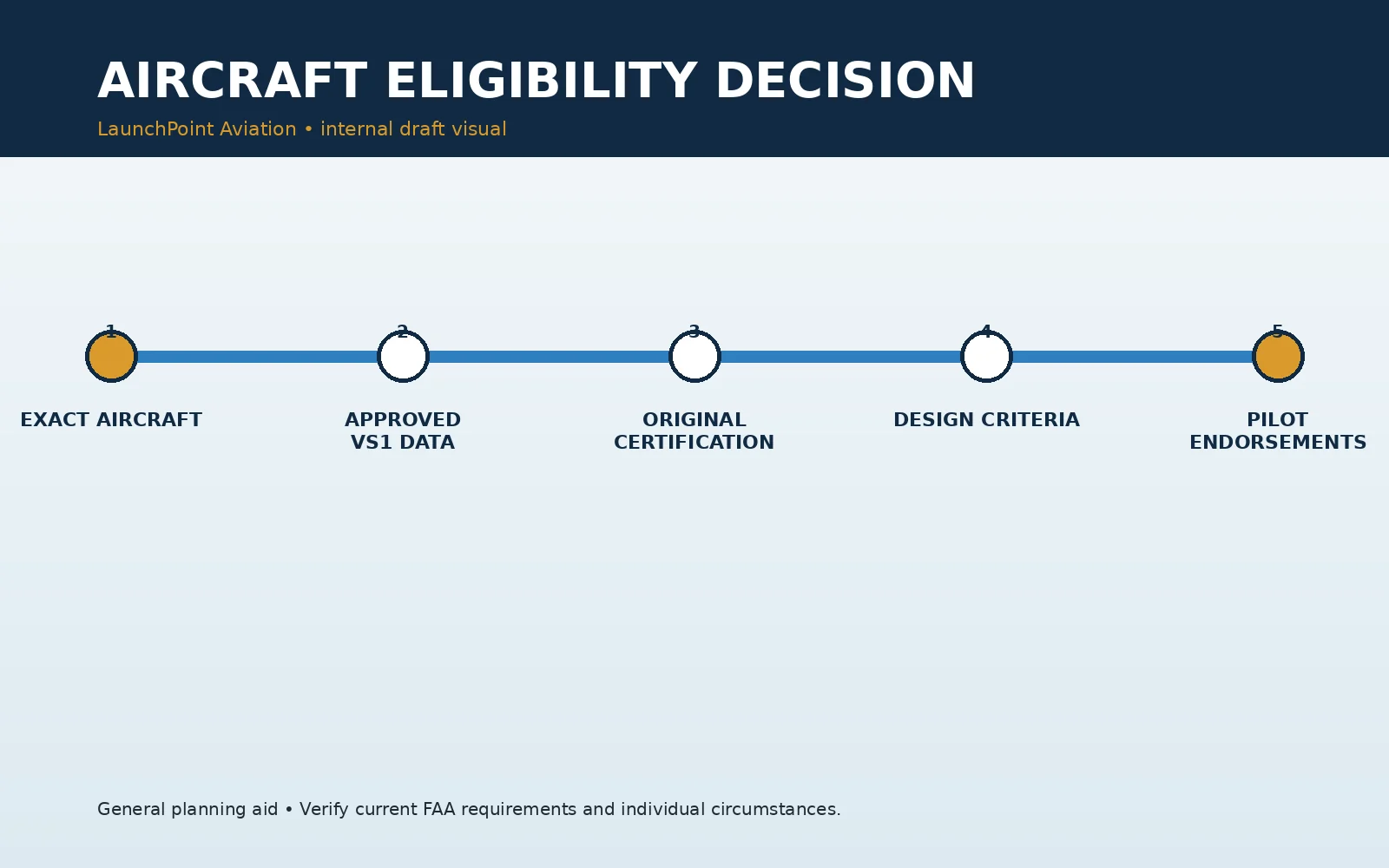
Table of contents
- The current eligibility test
- Why a model list is not enough
- Performance and design criteria
- Original certification and changes
- Seats and passenger privileges
- Gear, propellers, and speed
- How to evaluate an airplane
- Examples
- Checklist
- Frequently asked questions
The current eligibility test
The legal question is no longer “Was this airplane marketed or certificated as light-sport?” The current question is “Has this particular airplane met the applicable § 61.316 performance and design requirements since original certification, and is the pilot qualified for its features and the intended operation?”[1]
For the common airplane case, that inquiry includes:
- clean stall speed, expressed as VS1, at the required weight and center-of-gravity condition;
- certificated seating capacity;
- pressurization status;
- whether the airplane requires a type rating;
- powerplant and design limitations in the rule;
- original certification and subsequent configuration;
- VH-related training and endorsements;
- retractable-gear or controllable-pitch-propeller endorsements;
- category and class privileges; and
- operational limits such as passengers, altitude, weather, airspace, compensation, and night.[1][2]
An airplane can pass the aircraft test while the planned flight still fails an operating rule. Conversely, a pilot may hold the needed endorsements while the airframe does not meet § 61.316.
Why there is no reliable universal model list
Model lists are attractive because they make a complex question look certain. They are unreliable when they fail to address:
- Variants. A model family can include multiple engines, wings, weights, or approved configurations.
- Calibrated versus indicated speed. Section 61.316 uses KCAS. A cockpit placard or recollected indicated speed may not supply the required value.
- Weight and center of gravity. The stall-speed test is tied to maximum certificated takeoff weight and the most critical center of gravity.
- Original certification. A later change cannot necessarily be used to make an ineligible design qualify.
- Alterations. Supplemental type certificates, engine conversions, aerodynamic changes, or other approved alterations can affect the documentation and analysis.
- Records access. Some older flight manuals and type-certificate records do not present every needed figure in a convenient form.
- Non-aircraft limits. Insurance, rental, instruction, and examiner policies are separate from § 61.316.
The FAA’s post-MOSAIC advisory circular explicitly emphasizes the original-certification requirement and the removal of the former weight limit.[2] An online spreadsheet can be a research lead; it should not replace approved data and competent review.
Performance-based eligibility criteria
Stall speed
For an airplane, § 61.316(a) uses a VS1 limit of 59 knots calibrated airspeed at maximum certificated takeoff weight and the most critical center of gravity.[1] VS1 is the stalling speed or minimum steady flight speed obtained in a specified configuration. It is not interchangeable with every stall speed found in a handbook, and KCAS is not automatically the same as KIAS.
The person evaluating an airplane should locate the approved source for the applicable model and configuration and document how the value satisfies the rule. If the data is ambiguous, do not round a questionable number down or infer calibration from another variant.
Seats, pressurization, and type rating
A qualifying airplane may have no more than four certificated seats. Its cabin must be nonpressurized, and it cannot be an aircraft that requires a type rating. These constraints exclude aircraft far outside the intended sport envelope even when one isolated performance number looks favorable.[1]
Weight
MOSAIC removed the former 1,320-pound landplane and 1,430-pound seaplane limits from the sport-pilot aircraft test. Section 61.316 does not substitute a new 3,000-pound maximum for sport-pilot operation.[2] Some search results and industry summaries confuse proposed-rule or certification-category numbers with the final pilot-privilege rule.
Aircraft loading limits still apply. “No sport-pilot maximum weight in § 61.316” never means an aircraft may be loaded above its approved maximum or outside its center-of-gravity envelope.
Original certification and configuration
The rule measures the relevant aircraft characteristics since original certification. This guards against deliberately de-rating, placarding, or modifying an aircraft after certification solely to fit the sport boundary.[1][2]
The review should normally consider:
- the FAA type certificate data sheet for a type-certificated airplane;
- the approved airplane flight manual or pilot’s operating handbook;
- equipment lists and weight-and-balance records;
- supplemental type certificates and major alterations;
- applicable limitations and placards; and
- the aircraft’s airworthiness and maintenance status.
The owner’s statement that “all of this model qualifies” is not a substitute for those records. A flight school should preserve a documented eligibility determination for each airplane used in the sport program and recheck it after a configuration change.
Seating capacity versus passenger privileges
MOSAIC allows up to four certificated airplane seats under § 61.316, but § 61.315 still limits a sport pilot to one passenger.[1] A typical four-seat arrangement therefore supports the pilot and one passenger, with the remaining seats empty.
Do not confuse “seat” with “person.” Baggage carried on or near an empty seat must be secured and included in weight-and-balance calculations. A child is still a passenger. An instructor is an occupant whose role affects who is acting as pilot in command and which privileges are being exercised.
Gear, propeller, and speed considerations
Retractable landing gear
A qualifying airplane may have retractable gear, but § 61.331 requires applicable ground and flight training and an instructor endorsement before a sport pilot acts as pilot in command.[1]
Manually controllable-pitch propeller
The same section provides an endorsement path for airplanes with a manually controllable-pitch propeller. “Constant-speed propeller” is common practical language, but the regulatory phrase should guide the review.[1][2]
VH speed endorsements
Section 61.327 contains training and endorsement requirements tied to whether airplane VH is not greater than 87 KCAS or greater than 87 KCAS. A student’s solo requirements can also interact with the higher-speed provisions in Subpart C. Determine VH from authoritative aircraft data; do not substitute cruise speed from a sales page.[1]
Night and controlled airspace
Aircraft eligibility does not include automatic permission for night or controlled-airspace operations. Sections 61.325 and 61.329 contain separate training and endorsement requirements. Night adds a medical qualification condition.
How to evaluate a specific aircraft
Use a documented, two-person review when practical—such as an appropriately knowledgeable instructor and a maintenance or records professional.
- Record the exact make, model, series, serial-number range, and current configuration.
- Locate the current FAA type-certificate data and approved flight manual or operating handbook.
- Identify VS1 in KCAS at maximum certificated takeoff weight and most critical center of gravity.
- Confirm the certificated seat count, pressurization status, and lack of a type-rating requirement.
- Review whether the relevant characteristics have been satisfied since original certification.
- Review engine, propeller, landing gear, and approved alterations.
- Determine VH and the corresponding pilot/student endorsement requirements.
- Confirm category and class privileges and any needed feature endorsements.
- Match the intended flight to passenger, day/night, airspace, altitude, weather, and compensation limits.
- Confirm that the owner, school, insurer, and examiner accept the airplane for the intended use.
- Repeat the review after a material modification or regulatory change.
Examples, not an approved aircraft list
A former two-seat light-sport airplane
An aircraft that met the former light-sport definition may continue to fit the current sport-pilot criteria, but the pilot must still review its category/class privileges, current configuration, and operating limitations. Its marketing designation alone is not the legal conclusion.
A standard-category four-seat trainer
A common high-wing or low-wing trainer may now potentially qualify based on its approved stall-speed and design data. The rear seats do not expand the sport-pilot passenger privilege. A higher VH, retractable gear, or manual propeller control can add endorsements.
An altered airplane
An engine conversion, aerodynamic kit, weight increase, or other modification may require a deeper review. A post-certification change cannot be assumed to cure original ineligibility, and an otherwise qualifying base model does not automatically settle the altered airframe’s status.
Aircraft-eligibility checklist
- [ ] Exact aircraft and configuration identified
- [ ] Current type certificate data located
- [ ] Approved flight manual or operating handbook located
- [ ] VS1 confirmed in KCAS at the required condition
- [ ] Four or fewer certificated seats
- [ ] Nonpressurized cabin
- [ ] No type rating required
- [ ] “Since original certification” condition documented
- [ ] Alterations and supplemental type certificates reviewed
- [ ] VH documented from approved data
- [ ] Category and class privileges confirmed
- [ ] Speed, gear, and propeller endorsements confirmed
- [ ] Controlled-airspace and night requirements addressed
- [ ] One-passenger limit built into operating policy
- [ ] School and insurance permission confirmed
- [ ] Determination dated and retained for future review
Frequently asked questions
Is there an official complete sport-pilot aircraft list?
The FAA provides the controlling criteria and aircraft-record systems, not a universal warranty that every individual airframe on a named-model list qualifies. Use approved data for the particular aircraft.[1][3][4]
Can a sport pilot fly an airplane with four seats?
Potentially, if the airplane meets § 61.316 and all other requirements are satisfied. The sport pilot may still carry only one passenger.[1]
Can an aircraft be modified to qualify?
Do not assume so. The regulation evaluates the relevant characteristics since original certification, and the FAA advisory circular cautions against post-certification modification as a way to create eligibility.[1][2]
Do retractable gear and controllable-pitch propellers require endorsements?
Yes, § 61.331 requires applicable ground and flight training and a logbook endorsement before exercising those sport-pilot privileges.[1]
This article provides general aviation and regulatory information only. It does not determine any individual’s legal, medical, or operational eligibility to act as pilot in command. Readers should review current FAA materials and obtain appropriate individualized guidance when necessary.
Sources and further reading
[1] Electronic Code of Federal Regulations, “14 C.F.R. Part 61, Subpart J—Sport Pilots”. Reviewed 2026-07-22.
[2] Federal Aviation Administration, “AC 61-146, Pilot Certification and Operations for Sport Pilots”. Reviewed 2026-07-22. Published or updated 2025-11-14.
[3] Federal Aviation Administration, “Sport Pilot”. Reviewed 2026-07-22. Published or updated 2026-04-15.
[4] Federal Aviation Administration, “Design Approvals and Type Certificate Data Sheets”. Reviewed 2026-07-22. Published or updated 2024-09-12.
The eCFR is continuously updated and is authoritative but unofficial.
Related LaunchPoint guides
- the current MOSAIC overview — What MOSAIC Changed for Sport Pilots
- the qualified Cessna 172 analysis — Can a Sport Pilot Fly a Cessna 172?
- the sport-versus-private comparison — Sport Pilot Versus Private Pilot: Which Path Fits Your Goals?
LaunchPoint pre-launch disclosure
LaunchPoint Aviation Group, LLC is currently developing a proposed sport-pilot training program for the Ozarks, with an anticipated launch in 2027. LaunchPoint is not presently offering flight instruction, aircraft rental, enrollment, scheduling, discovery flights, or paid aviation services. Program details, aircraft, instructors, airport location, pricing, and launch timing remain subject to change.
Corrections and updates
To report a possible error or suggest an update, contact admin@launchpointaviation.com with the article title, the passage in question, and a link to any supporting official source. Do not send medical records, diagnoses, government identifiers, or other sensitive personal information.
Stay informed
Interested in sport-pilot training in the Ozarks?
Join the LaunchPoint Aviation 2027 Interest List to receive occasional development updates and be notified when enrollment information becomes available.
Joining the interest list is not enrollment, does not reserve a position, and creates no payment obligation.