
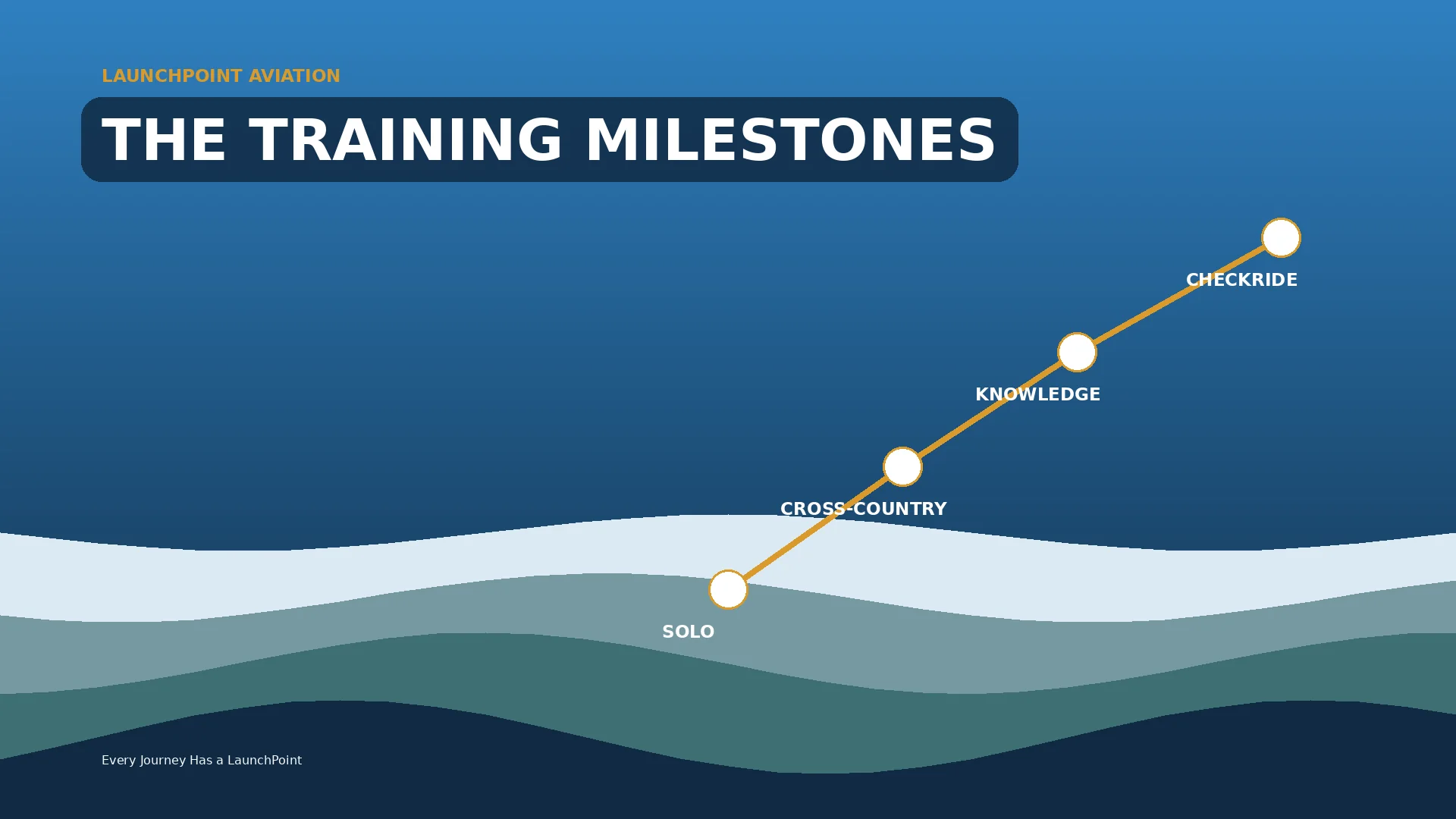
For airplane sport-pilot privileges, current 14 C.F.R. § 61.313 generally requires at least 20 total flight hours: 15 hours of flight training and 5 hours of solo flight. Within that experience, the applicant must complete specified cross-country instruction, full-stop landings, a solo cross-country of at least 75 nautical miles total with defined landing and segment requirements, and recent practical-test preparation.[2]
Those totals do not stand alone. Before solo, the student needs a student-pilot certificate, pre-solo knowledge and flight training, and current make-and-model endorsements. Before cross-country solo, additional training, planning, and flight-specific endorsements apply. The applicant must also pass the FAA knowledge test and a practical test using current standards. Every logged hour and endorsement should be audited well before the checkride.
Accurate as of July 22, 2026.
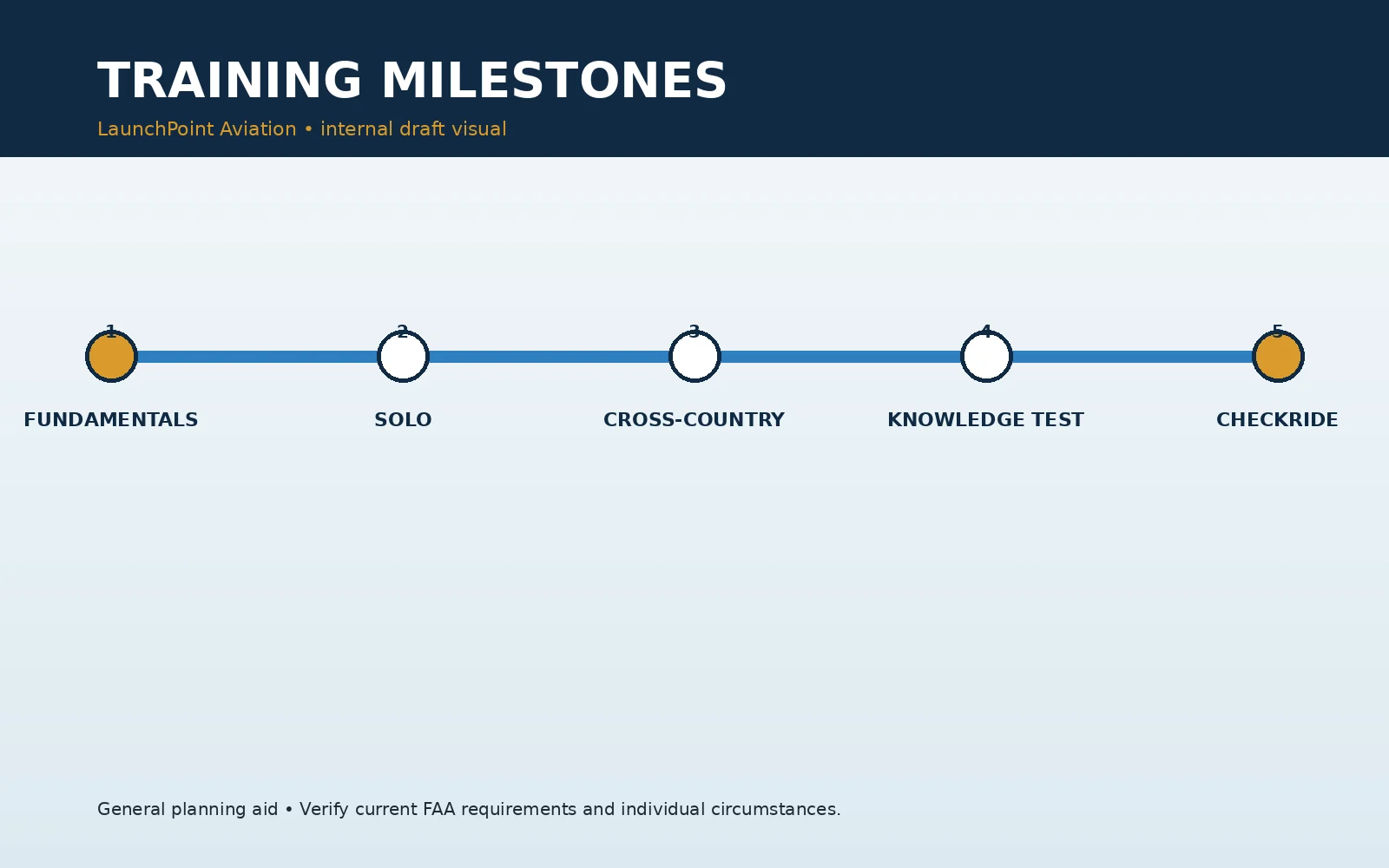
Table of contents
- Pre-solo training
- Endorsements
- Solo experience
- Cross-country
- Knowledge test
- Practical test
- Documents
- Common mistakes
- Training sequence
- Frequently asked questions
Pre-solo training
Solo is not based on reaching a universal hour number. Section 61.87 requires the student to complete a pre-solo aeronautical-knowledge test administered and reviewed by an authorized instructor, receive the required training for the aircraft category and class, and demonstrate satisfactory proficiency and safety in the make and model to be flown.[1]
For an airplane, training covers applicable preflight planning and preparation; airport operations; takeoffs, landings, and go-arounds; turns and maneuvering; slow flight and stalls; emergency procedures; ground-reference maneuvers; traffic patterns; collision, wake-turbulence, and wind-shear avoidance; and other listed subjects.[1]
The instructor corrects missed pre-solo test answers and records the required endorsement. This local pre-solo test is not the FAA Sport Pilot Airplane knowledge test. They are separate assessments serving different purposes.
Before solo, the student must also satisfy the student-certificate and medical-document rules. Many eligible daytime sport students may use a current and valid U.S. driver’s license under the applicable conditions. A school’s insurance may be more restrictive.
Required solo endorsements
The endorsement set depends on the student, aircraft, airport, route, and operation. Current AC 61-65K provides sample language, while the regulations control.[1][5]
Common items include:
- pre-solo aeronautical knowledge;
- pre-solo flight training and proficiency;
- initial and recurring authorization for solo in a specific make and model;
- any required VH speed-range training and endorsement;
- controlled-airspace or towered-airport authorization where applicable;
- solo cross-country training;
- preparation and planning for the specific cross-country flight; and
- any additional route, airport, weather, or aircraft limitations imposed by the instructor.
An endorsement is not permission to ignore its limitations. It may specify wind, visibility, runway, airport, route, daylight, or other conditions. The student should be able to explain every endorsement in the logbook.
Duration and currency
The make-and-model solo endorsement is generally limited to 90 days and must be renewed when appropriate.[1] A flight-specific cross-country endorsement does not replace that underlying authorization. Schools should use an endorsement checklist tied to the current regulation and advisory circular rather than depend on memory.
Required solo flight experience
For airplane single-engine land or sea privileges, the 20-hour minimum includes at least 5 hours of solo flight.[2] The rule also requires 10 takeoffs and 10 landings to a full stop, with each landing involving flight in the traffic pattern.
Solo time means the student is the sole occupant. A flight with an instructor aboard is dual training, not solo, even if the student manipulates the controls for the entire lesson.
The five hours may include local practice and the required solo cross-country. More solo time may be appropriate when safely authorized, but solo is not a cheap substitute for needed dual instruction.
Cross-country requirements
Dual cross-country training
Section 61.313 requires at least 2 hours of cross-country flight training for the airplane pathway.[2] Older summaries may state three hours; use the current regulation. Cross-country training should cover route selection, charts, airspace, weather, fuel, performance, navigation systems, pilotage, dead reckoning, diversions, lost procedures, communications, airport information, and aeronautical decision-making.
Solo cross-country aeronautical experience
The current airplane requirement includes one solo cross-country flight with:
- at least 75 nautical miles total distance;
- full-stop landings at a minimum of two points; and
- at least one segment consisting of a straight-line distance of 25 nautical miles or more between takeoff and landing locations.[2]
The route should be documented so that the distance and landing conditions are clear. “I flew around for 75 miles” is not sufficient if the required points and segment are missing.
Flight-specific review
Before authorizing the flight, the instructor reviews the planning, weather, aircraft performance, runway data, airspace, notices, fuel, alternates, and student readiness. Conditions can change after endorsement. The student retains a duty to cancel or divert when the flight is no longer safe or within limitations.
The FAA knowledge test
The Sport Pilot Airplane knowledge test covers the aeronautical knowledge areas in § 61.309.[2] Before testing, an authorized instructor must certify that the applicant is prepared.
The FAA testing matrix reviewed July 22, 2026, lists:
- test code SPA;
- 40 multiple-choice questions;
- 2 hours allotted;
- a minimum testing age of 15; and
- a passing score of 70 percent.[4]
Testing information can change, so confirm the matrix and provider instructions before scheduling. A satisfactory test result generally expires 24 calendar months after the month taken if the practical test is not completed within that period.
The test report identifies deficient subject-matter codes. The recommending instructor must review the weak areas and provide the appropriate endorsement before the practical test. A passing score is not permission to ignore missed concepts.
The practical test, or checkride
The airplane sport practical test includes an oral evaluation and a flight evaluation conducted under the current FAA practical-test standard.[3] The evaluator assesses knowledge, risk management, aircraft control, procedures, judgment, and compliance with tolerances.
Recent training
Section 61.313 currently requires 2 hours of flight training in preparation for the practical test within the two calendar months preceding the month of the test.[2] Older three-hour or 60-day summaries can be misleading after rule changes.
Instructor recommendation
The instructor’s endorsement certifies that the applicant has received the required training, meets the aeronautical-knowledge and proficiency requirements, and is prepared. It is not a courtesy triggered by paying an examiner fee.
Aircraft
The checkride aircraft must be airworthy, appropriately equipped, and accepted for the tasks. For a sport-pilot applicant, its § 61.316 eligibility and any speed or feature endorsements should be confirmed. Insurance and examiner requirements should be addressed before scheduling.
Documents and records to review
The exact list should be confirmed with the evaluator and current FAA guidance. A typical pre-checkride records audit includes:
- acceptable government-issued photo identification for testing and application steps;
- student-pilot certificate and pilot application records;
- applicable FAA medical certificate, valid U.S. driver’s license, or BasicMed documentation for the operation;
- logbook with total, dual, solo, cross-country, landing, and recent-training entries;
- pre-solo, make-and-model, cross-country, speed, airspace, and other applicable endorsements;
- knowledge-test report with deficiency review endorsement;
- practical-test recommendation and prerequisites under § 61.39;
- completed IACRA application or current alternative process;
- aircraft registration and airworthiness documents;
- operating limitations, weight and balance, and maintenance status; and
- examiner-requested cross-country planning assignment.
Do not send identity or medical documents through LaunchPoint’s public interest form. This list is for future operational planning and applicant preparation.
Common readiness and recordkeeping mistakes
Counting total hours but not categories
Twenty total hours do not prove that the 15 dual, 5 solo, 2 dual cross-country, solo route, full-stop landing, and recent-preparation requirements are all met.[2]
Using old summaries
Post-MOSAIC rules changed several details. Relying on an old poster or blog can produce wrong training-hour, speed-endorsement, aircraft, or night assumptions.
Missing calibrated aircraft data
The checkride plan may fail if the school cannot document that the airplane qualifies under § 61.316. Verify the aircraft early.
Expired solo endorsement
A student may have logged valid solo previously but lack current authority for a new solo flight. Check endorsement dates and limitations before dispatch.
Incomplete knowledge-test follow-up
A passing report still requires review of deficient areas. Preserve the report and endorsement.
Scheduling before readiness
Examiner availability can tempt students to reserve a date early. A tentative plan is not an instructor recommendation. Build enough time for records review, mock oral work, maintenance, weather, and lawful recent training.
Sample training sequence
| Stage | Typical focus | Required decision or record |
|---|---|---|
| 1. Orientation | Goals, certificate path, medical-document pathway, aircraft eligibility | Written training and cost plan |
| 2. Fundamentals | Ground knowledge, aircraft control, patterns, emergencies | Lesson records and study assignments |
| 3. Pre-solo | § 61.87 test and maneuvers, consistent takeoffs and landings | Corrected test and solo endorsements |
| 4. Local solo | Pattern and local-area proficiency within limitations | Current make-and-model authorization |
| 5. Cross-country | Dual navigation and planning, route-specific readiness | Cross-country training and endorsements |
| 6. Knowledge test | Structured review and FAA test | Test report and deficiency review |
| 7. Integration | Maneuvers, navigation, risk management, weak areas | Progress and experience audit |
| 8. Checkride preparation | Recent required training, mock oral and flight | Recommendation, IACRA, aircraft and record audit |
This sequence is illustrative. A safety-centered instructor may move topics, repeat stages, or delay solo based on the individual and conditions.
Frequently asked questions
How many solo hours are required?
At least 5 hours for the common airplane single-engine path, within at least 20 total hours and all other specified categories.[2]
What is the required solo cross-country distance?
At least 75 nautical miles total, with full-stop landings at a minimum of two points and one straight-line segment of at least 25 nautical miles.[2]
How long is a passed knowledge test valid?
Generally 24 calendar months after the month taken for purposes of completing the applicable practical test. Verify the current § 61.39 rule and test report.
Who conducts the practical test?
An FAA inspector or an appropriately authorized designated pilot examiner may conduct it. Availability, fee, and aircraft acceptance should be confirmed directly.[7]
This article provides general aviation and regulatory information only. It does not determine any individual’s legal, medical, or operational eligibility to act as pilot in command. Readers should review current FAA materials and obtain appropriate individualized guidance when necessary.
Sources and further reading
[1] Electronic Code of Federal Regulations, “14 C.F.R. Part 61, Subpart C—Student Pilots”. Reviewed 2026-07-22.
[2] Electronic Code of Federal Regulations, “14 C.F.R. Part 61, Subpart J—Sport Pilots”. Reviewed 2026-07-22.
[3] Federal Aviation Administration, “Pilot Practical Test Standards”. Reviewed 2026-07-22. Published or updated 2026-06-08.
[4] Federal Aviation Administration, “Airman Knowledge Testing Authorization Requirements Matrix”. Reviewed 2026-07-22. Published or updated Current file reviewed 2026-07-22.
[5] Federal Aviation Administration, “AC 61-65K, Certification: Pilots and Flight and Ground Instructors”. Reviewed 2026-07-22. Published or updated 2025-11-14.
[6] Federal Aviation Administration, “Integrated Airman Certification and Rating Application”. Reviewed 2026-07-22.
[7] Federal Aviation Administration, “Find a Designee”. Reviewed 2026-07-22.
The eCFR is continuously updated and is authoritative but unofficial.
Related LaunchPoint guides
- the complete sport-pilot requirements guide — Sport Pilot License Requirements: A Complete Current Guide
- the sport-pilot budgeting guide — How Much Does a Sport Pilot Certificate Cost?
- the flight-school selection checklist — How to Choose a Sport-Pilot Flight School
LaunchPoint pre-launch disclosure
LaunchPoint Aviation Group, LLC is currently developing a proposed sport-pilot training program for the Ozarks, with an anticipated launch in 2027. LaunchPoint is not presently offering flight instruction, aircraft rental, enrollment, scheduling, discovery flights, or paid aviation services. Program details, aircraft, instructors, airport location, pricing, and launch timing remain subject to change.
Corrections and updates
To report a possible error or suggest an update, contact admin@launchpointaviation.com with the article title, the passage in question, and a link to any supporting official source. Do not send medical records, diagnoses, government identifiers, or other sensitive personal information.
Stay informed
Interested in sport-pilot training in the Ozarks?
Join the LaunchPoint Aviation 2027 Interest List to receive occasional development updates and be notified when enrollment information becomes available.
Joining the interest list is not enrollment, does not reserve a position, and creates no payment obligation.