
A sport pilot may be able to fly a qualifying Cessna 172 after the MOSAIC sport-pilot changes, but the safe legal answer is not “every 172 automatically qualifies.” The particular aircraft, model and series, original certification, approved stall-speed data, current configuration, alterations, and intended operation must be reviewed against 14 C.F.R. § 61.316.[1][2] A sport pilot also needs any applicable speed, airspace, gear, propeller, or night endorsements.
Many 172-series airplanes are four-seat, nonpressurized, single-engine trainers and are commonly discussed as potential post-MOSAIC sport aircraft. Four seats do not authorize four occupants: while exercising sport privileges, the pilot may carry no more than one passenger.[1] Federal eligibility also does not guarantee that a school, aircraft owner, or insurer will permit sport training or driver’s-license-only student solo in that airplane.
Accurate as of July 22, 2026.
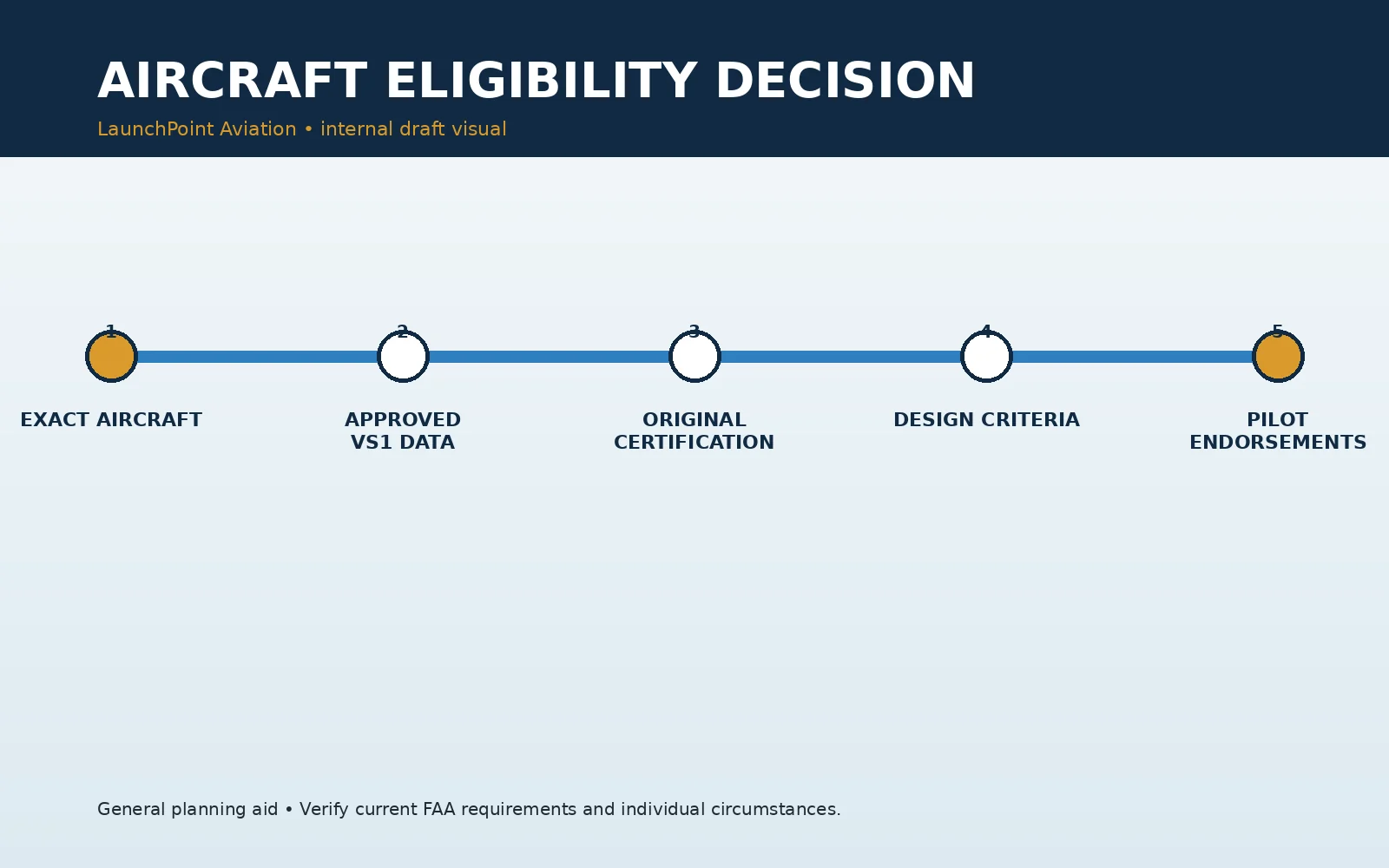
Table of contents
- The qualified answer
- Why MOSAIC changed the analysis
- Exact-aircraft review
- Speed and endorsements
- Seats, day, and night
- Insurance and school policy
- Training advantages
- Limitations and concerns
- Frequently asked questions
The qualified answer
The model name “Cessna 172” describes a broad family produced across many years and configurations. FAA Type Certificate Data Sheet 3A12 covers numerous 172 variants, while related or modified aircraft can involve different records.[5] The sport-pilot question must therefore be answered at the level of the particular aircraft and configuration.
A defensible conclusion should identify at least:
- the exact model and serial-number applicability;
- the aircraft’s approved flight manual or pilot’s operating handbook;
- VS1 in calibrated airspeed at maximum certificated takeoff weight and the most critical center of gravity;
- the certificated seat count and pressurization status;
- original certification and relevant alterations;
- VH for the speed-endorsement analysis;
- landing gear and propeller configuration;
- the pilot’s category/class privileges and endorsements; and
- owner, school, insurance, and examiner acceptance.
If those records are unavailable or ambiguous, “it looks like a normal 172” is not enough.
Why the answer changed under MOSAIC
Before October 22, 2025, ordinary four-seat Cessna 172 aircraft did not fit the former light-sport aircraft definition used for sport-pilot operations. MOSAIC removed that dependency and placed aircraft criteria in § 61.316.[2][3]
The current airplane criteria use a performance and design framework. The central stall-speed threshold is VS1 not greater than 59 KCAS at the specified weight and center-of-gravity condition, and the airplane may have up to four certificated seats. The former sport-operating maximum-weight rule is gone.[1][2]
That change makes the 172 family relevant to sport-pilot planning. It does not create a manufacturer-wide declaration that every aircraft bearing the number 172 qualifies. The regulation’s “since original certification” language and the need for calibrated performance data make variant and records review essential.
Review the particular aircraft and configuration
Start with authoritative documents
FAA design-approval resources and the Dynamic Regulatory System provide access to type-certificate data sheets.[4] For a 172-series review, TCDS 3A12 is an important starting point, but it is not necessarily the only document. The approved aircraft flight manual or pilot’s operating handbook, equipment list, weight-and-balance record, supplemental type certificates, major alterations, and current limitations complete the picture.[5]
The review should use the revision that applies at the time of the decision. A search-engine copy of an old TCDS may help identify the document but should not be treated as the current controlling record when the FAA system is available.
Confirm calibrated stall-speed data
Section 61.316 specifies KCAS, not a casual recollection of the airspeed indicator during a practice stall.[1] Indicated and calibrated values can differ. The condition also matters: maximum certificated takeoff weight and the most critical center of gravity.
If a handbook provides only values for a different flap configuration, weight, or model, do not interpolate without a sound approved basis. The aircraft eligibility file should record the exact page and source used.
Review alterations
Engine conversions, gross-weight increases, vortex generators, leading-edge modifications, propeller changes, and other alterations may change performance or documentation. Some changes may improve a value, but the rule asks whether the aircraft has met the criteria since original certification. A later modification cannot simply be assumed to create eligibility.[1][2]
An appropriately knowledgeable instructor may need help from an airframe and powerplant mechanic, inspection authorization holder, type-club technical resource, manufacturer data, or the FAA to resolve uncertain records. That is responsible due diligence, not unnecessary paperwork.
Speed and endorsement issues
VH endorsement
MOSAIC removed the former blanket maximum-speed boundary, but § 61.327 still uses airplane VH to define training and endorsement paths. A pilot who has not logged the qualifying prior experience must receive the applicable ground and flight training and logbook endorsement for the relevant speed range.[1][2]
Do not substitute maximum structural cruising speed, never-exceed speed, or a marketing cruise figure for VH. Use the definition and approved data applicable to the aircraft.
Fixed gear and fixed-pitch propeller
Many familiar training 172 configurations use fixed tricycle landing gear and a fixed-pitch propeller. Those configurations do not trigger the retractable-gear or manually controllable-pitch-propeller endorsement simply because MOSAIC created those endorsement categories.
Modified or related configurations
A particular airplane may have a different engine or propeller installed under approved data, or it may belong to a related model that people colloquially call a 172. The paperwork, not the nickname, controls. If retractable gear or a manually controllable-pitch propeller is present and the aircraft otherwise qualifies, § 61.331 training and endorsement requirements must be addressed.[1]
Four seats, occupants, day, and night
Four seats do not mean three passengers
A § 61.316-qualifying airplane may have four seats. Section 61.315 still limits the sport pilot to one passenger.[1] In a four-seat trainer, the remaining seats must not be occupied by additional passengers while the pilot is exercising sport privileges.
Weight and balance remain essential even with only two people. Fuel, baggage, installed equipment, and seating position must fit the approved envelope.
Day operations
For many eligible people, daytime sport operations may use the current and valid U.S. driver’s-license pathway, subject to prior FAA medical history, restrictions, and fitness-to-fly duties. The aircraft must be equipped and operated under the applicable day visual-flight rules, visibility, airspace, and altitude limitations.
Night operations
A 172’s lighting and night certification do not grant the pilot night privilege. Under § 61.329, a sport pilot needs specified night ground and flight training, an instructor endorsement, and either at least a third-class medical or the driver’s-license-plus-BasicMed path described in the rule.[1]
The school or insurer may impose additional experience, recency, or weather requirements. Night operations should be explicitly included or excluded in the school’s written sport-pilot policy.
Insurance and school policy
Federal regulations set the legal boundary. They do not require an aircraft owner or insurer to accept every federally permitted use.
Before assuming a 172 is available for a sport-pilot program, ask:
- Does the policy cover primary sport-pilot instruction in this aircraft?
- Does it cover student solo based on the driver’s-license medical pathway?
- Are there instructor-hour or qualification minimums?
- Are there student age, citizenship, or record requirements?
- Are there named-pilot, open-pilot-warranty, or checkout conditions?
- Does coverage continue during practical testing with the planned evaluator?
- Are passenger, night, cross-country, or weather limits more restrictive?
- What renter or non-owned-aircraft coverage is required?
The answer should be confirmed in writing by the appropriate party. A front-desk assurance is not the same as reviewing the policy and endorsements.
School policy can also be narrower for safety or operational reasons. A school may decide not to offer sport training, not to permit driver’s-license-only solo, or not to use a qualifying aircraft for student solo. A prospective student should learn that before transferring money or committing to a schedule.
Possible training advantages
When a particular 172 qualifies and the operational pieces align, the type can offer practical benefits:
- broad instructor familiarity;
- established maintenance knowledge and parts support;
- side-by-side seating suited to instruction;
- a cabin and payload that may support varied student sizes within weight and balance;
- common conventional flight instruments and training configurations;
- potential continuity if the student later pursues private-pilot training; and
- potential availability in regions where pre-MOSAIC two-seat light-sport trainers were scarce.
These are general characteristics, not claims about any LaunchPoint aircraft. Aircraft condition, avionics, useful load, dispatch reliability, control feel, and cost vary significantly across individual 172s.
Limitations and operational concerns
Operating cost
A larger legacy trainer may cost more per hour than some purpose-built two-seat aircraft. Fuel, engine reserves, avionics, insurance, maintenance, and local rental structure drive the actual figure. MOSAIC eligibility does not guarantee lower-cost training.
Maintenance and dispatch
Age alone does not determine airworthiness, but many training aircraft have decades of service. Logs, inspections, corrosion history, engine condition, parts availability, recurring discrepancies, and a realistic maintenance plan affect dispatch reliability.
Student access
An airplane can be legally eligible and still be unavailable for student solo. The training provider needs scheduling capacity, an appropriate instructor, maintenance coverage, insurance approval, and a practical examiner who will accept the aircraft.
Transition and endorsement planning
A student training in a higher-VH airplane should receive the current speed-related training and endorsements at the correct stage. The syllabus should not discover the requirement at the checkride records review.
How a school should document eligibility
A school should document the aircraft’s eligibility using approved aircraft records and update that determination after material maintenance changes, alterations, rule changes, or new FAA guidance.
Frequently asked questions
Does every Cessna 172 qualify?
No universal statement should be made without reviewing the particular model, aircraft, original certification, calibrated performance data, and configuration under current § 61.316.[1][2]
Can a sport pilot carry three passengers in a C172?
No. A sport pilot may carry no more than one passenger, even in a qualifying four-seat airplane.[1]
Is a special endorsement always required?
The answer depends on the aircraft and operation. VH, controlled airspace, night, retractable gear, and manually controllable-pitch propeller provisions may require endorsements. A familiar fixed-gear, fixed-pitch configuration does not automatically trigger every new endorsement.
Does LaunchPoint own a C172?
No aircraft has been publicly finalized for LaunchPoint’s planned program. This article discusses a Cessna 172 as a general regulatory and training example and does not imply ownership, acquisition, insurance approval, or future selection.
This article provides general aviation and regulatory information only. It does not determine any individual’s legal, medical, or operational eligibility to act as pilot in command. Readers should review current FAA materials and obtain appropriate individualized guidance when necessary.
Sources and further reading
[1] Electronic Code of Federal Regulations, “14 C.F.R. Part 61, Subpart J—Sport Pilots”. Reviewed 2026-07-22.
[2] Federal Aviation Administration, “AC 61-146, Pilot Certification and Operations for Sport Pilots”. Reviewed 2026-07-22. Published or updated 2025-11-14.
[3] Federal Aviation Administration, “Sport Pilot”. Reviewed 2026-07-22. Published or updated 2026-04-15.
[4] Federal Aviation Administration, “Design Approvals and Type Certificate Data Sheets”. Reviewed 2026-07-22. Published or updated 2024-09-12.
[5] Federal Aviation Administration Dynamic Regulatory System, “Type Certificate Data Sheet 3A12—172 Series”. Reviewed 2026-07-22. Published or updated Current DRS record.
The eCFR is continuously updated and is authoritative but unofficial.
Related LaunchPoint guides
- the aircraft-eligibility guide — What Airplanes Can a Sport Pilot Fly After MOSAIC?
- the current MOSAIC overview — What MOSAIC Changed for Sport Pilots
- the sport-versus-private comparison — Sport Pilot Versus Private Pilot: Which Path Fits Your Goals?
- the flight-school selection checklist — How to Choose a Sport-Pilot Flight School
LaunchPoint pre-launch disclosure
LaunchPoint Aviation Group, LLC is currently developing a proposed sport-pilot training program for the Ozarks, with an anticipated launch in 2027. LaunchPoint is not presently offering flight instruction, aircraft rental, enrollment, scheduling, discovery flights, or paid aviation services. Program details, aircraft, instructors, airport location, pricing, and launch timing remain subject to change.
Corrections and updates
To report a possible error or suggest an update, contact admin@launchpointaviation.com with the article title, the passage in question, and a link to any supporting official source. Do not send medical records, diagnoses, government identifiers, or other sensitive personal information.
Stay informed
Interested in sport-pilot training in the Ozarks?
Join the LaunchPoint Aviation 2027 Interest List to receive occasional development updates and be notified when enrollment information becomes available.
Joining the interest list is not enrollment, does not reserve a position, and creates no payment obligation.